
What is a Proforma Invoice?
A proforma invoice is a type of preliminary document. Seller issues this document to the buyer before service is finalised or the actual sale of a package. This document works as a clear estimation of services or goods being offered to the client, along with pricing terms and taxes. It is important to know that this is not the final invoice, but a formal confirmation of intent to give assurance to the buyer.
Travel businesses use this document to ensure that both parties are aligned on conditions, scope, and cost before making any payment.
Purpose of Proforma Invoice
Clarity and commitment are the two main reasons for issuing a proforma invoice. This document is helpful in avoiding any disputes as it works on settling expectations upfront. Some reasons travel businesses issue a proforma invoice include:
- To share accurate costs before the final confirmation to buyer
- To get approval from the customer or internal teams
- For requesting partial payment or advance
- It is also a reference document for invoicing
In most of the cases, a proforma invoice is the first document exchanged between the buyer and the seller after finalising the service or package to be provided.
Proforma Invoice vs Quotation vs Tax Invoice
It has been seen that most of the people get confused between these three documents. Although they can sound confusing, all of these documents serve different roles.
- A quotation is the document used for offering initial price to the customer for their query. A quotation is flexible and it can be changed on the basis of requirements and discussions with the client multiple times.
- A proforma invoice is a document which is more structured in comparison to the quotation. This document confirms final terms, quantity, rate, final cost and taxes to the client after they have confirmed a package. This document is usually shared when the customer is ready to proceed with the services.
- A tax invoice is the document which is issued at the final stage. It is a legally valid document that is issued after the delivery of goods and services promised to the client. Its purpose is to support accounting and tax filing procedures.
In short, all these documents serve different purposes and are issued at different stages of customer communication. A quotation is shared at the enquiry stage, a proforma invoice is issued once the customer finalises the services, and the actual invoice is generated after the services are delivered.
What Details Must a Proforma Invoice Format Include?
In a standard proforma invoice details that must be included are:
| Items | Purpose |
| Seller Details | Identifies the business issuing the proforma invoice, details include name, address, & contact information |
| Buyer Details | This includes the client details such as name & address for reference & approval |
| Issue Date | Indicates when the proforma invoice was created |
| Validity Date | Specifies how long the quoted prices and terms remain applicable |
| Trip ID/Booking ID/Reference ID | Uniquely identifies a specific trip or booking |
| Description of Services / Products | Explains exactly what is being offered to avoid misunderstandings |
| Quantity & Unit Price | Breaks down pricing clearly for transparency |
| Taxes (GST / VAT) | Shows applicable taxes separately for clarity and compliance |
| Total Amount | Displays the estimated payable amount |
| Notes / Terms & Conditions | Covers cancellation policy, revisions, or special instructions |
| Proforma Invoice Disclaimer | Clearly states that the document is not a final invoice |
| Bank Account details/Company’s Payment Details | So the customer knows where to make payment |
Download & Edit Proforma Invoice for Free
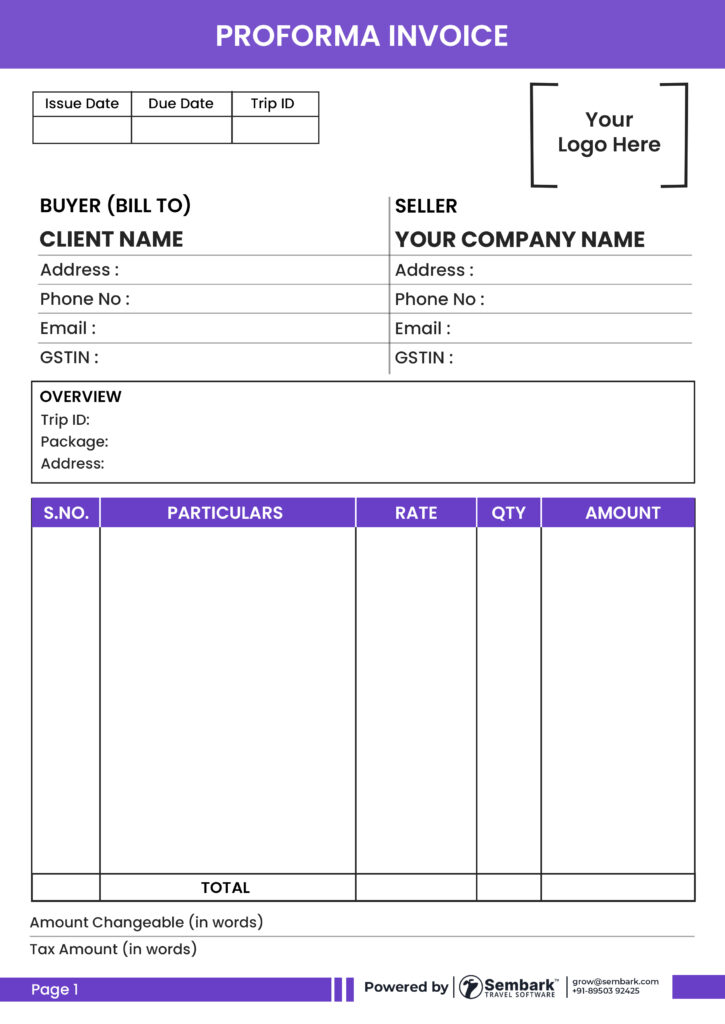
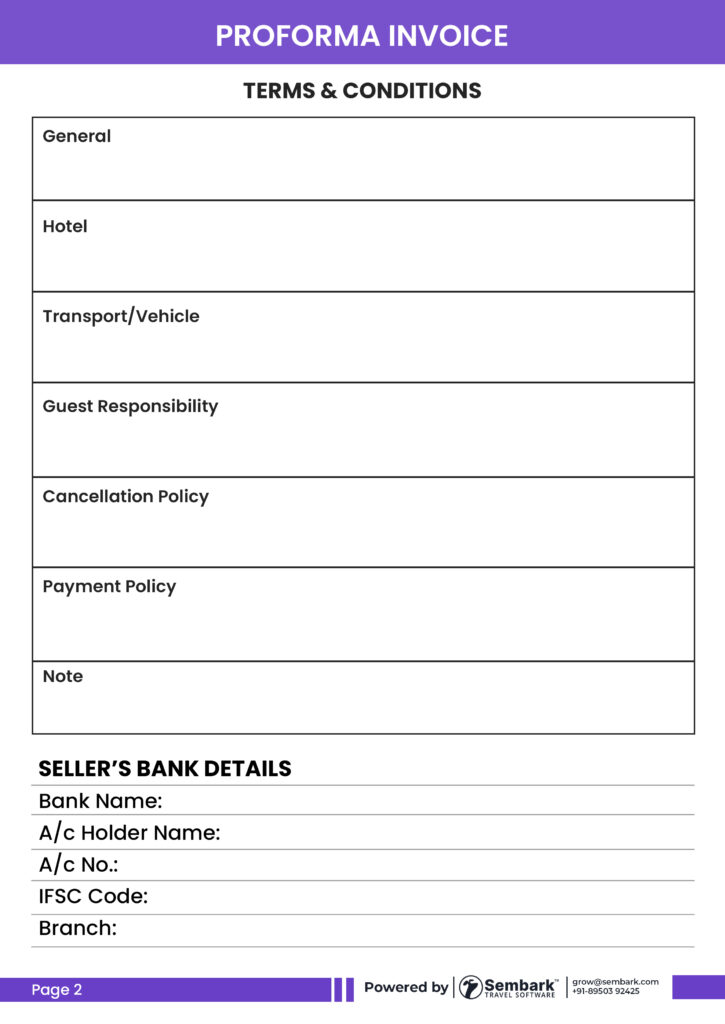
Filling this template by hand for every booking? A proforma invoice software can generate it straight from your confirmed quotation, with client details, taxes and payment terms already filled in.
Some general questions related to Proforma Invoice
When Should You Issue a Proforma Invoice?
A travel business should issue a proforma invoice when a customer has a serious intent to buy and requires a formal document before making any payment/instalment and approving the deal. It is commonly shared before collecting advance payments, starting operations or confirming bookings.
Is a Proforma Invoice Legally Valid?
Unlike a tax invoice, a proforma invoice is not legally binded. This document cannot be utilised in accounting, revenue recognition or GST claims. But still, it is one of the most important commercial documents as it reflects agreed terms.
Common Mistakes to Avoid in a Proforma Invoice
Here are some common mistakes to avoid:
- Do not read proforma invoice as final invoice
- Do not miss important details such as payment terms or validity dates
- Calculations should not be wrong for pricing or tax
- Service description should not be vague, but accurate about what is to be delivered
- Always update if there is any scope of change in pricing or services
Not avoiding these mistakes would lead to delayed payment, confusion or disputes later
Why Do Businesses Use a Proforma Invoice?
Travel businesses use proforma invoice for:
- Maintaining professionalism and building trust
- Reducing any type of disputes
- Accelerating payments and approvals
- Initiating better coordination between operations, finance, and sales
It can be said that a proforma invoice as a document acts like a bridge between discussion and execution.
Related Blog: Download Free Tour Booking Voucher
Now ask yourself one question in 2026: How are you creating your proforma invoices?
A travel business generates hundreds of proforma invoices every month and thousands over a year. If creating just one proforma invoice manually takes around 10 minutes, that adds up to hours every month and several working days every year spent on repetitive work.
That is valuable manpower being wasted on a simple, non-strategic task. Whether you are a DMC, an Outbound Tour Operator, a B2B Hotel Reseller, or a Travel Agent, this problem is the same across the board.
More importantly, manual proforma invoices increase the chances of pricing errors, missing details, wrong taxes, and inconsistent formats, which later lead to revisions, delays, and unnecessary back-and-forth with clients.
This is where automation becomes essential, not optional.
Streamline Your Proforma Invoice Operations with Sembark
SEMBARK Travel CRM Software enables instant proforma invoice generation as part of your workflow, not an additional manual task. From client details and travel services to taxes, payment terms, and branding, everything is auto-filled and standardised. What earlier took 10 minutes now takes seconds. From Smart Itinerary Builder to Payment & Collection Tracking, every step that feeds into a proforma is already happening inside your workflow.
With nearly a decade of expertise in the travel industry, Sembark is trusted by 1000+ DMCs, tour operators, and travel agencies across 28+ countries, built specifically for the way travel businesses operate.
While downloading free proforma invoice templates works as a starting point, manually filling Word or Excel sheets for every booking quickly becomes a bottleneck as your volume scales. Copy-pasting client details, recalculating taxes, and editing itemised service tables for hundreds of monthly bookings pull your team away from what actually drives growth.
Here is what changes when you switch to Sembark:
- One-Click Proforma Invoice Generation: Once your quotation is finalised, Sembark generates a fully structured, branded proforma invoice in a single click directly from confirmed trip data, with zero manual entry, including the costing already calculated by the AI trip planner.
- Revision and Version Control: Update proforma invoices without losing previous versions. Every revision is tracked and accessible, so your team always shares the correct and most recent document with every client.
- Customisable Templates: Tailor your invoice layout with your branding, logo, and payment terms, maintaining professional consistency across every client communication.
- Multi-Currency Support: Generate proforma invoices in multiple currencies for international clients without any additional effort.
- Real-Time Payment Tracking: Once a proforma invoice is shared, monitor all incoming payments and outstanding balances in real time, all within the same workflow.
Ready to ditch the spreadsheet chaos?
Stop spending hours creating proforma invoices manually. See how Sembark can help you automate your proforma invoice generation, eliminate calculation errors, and speed up client confirmations.
Read More: