
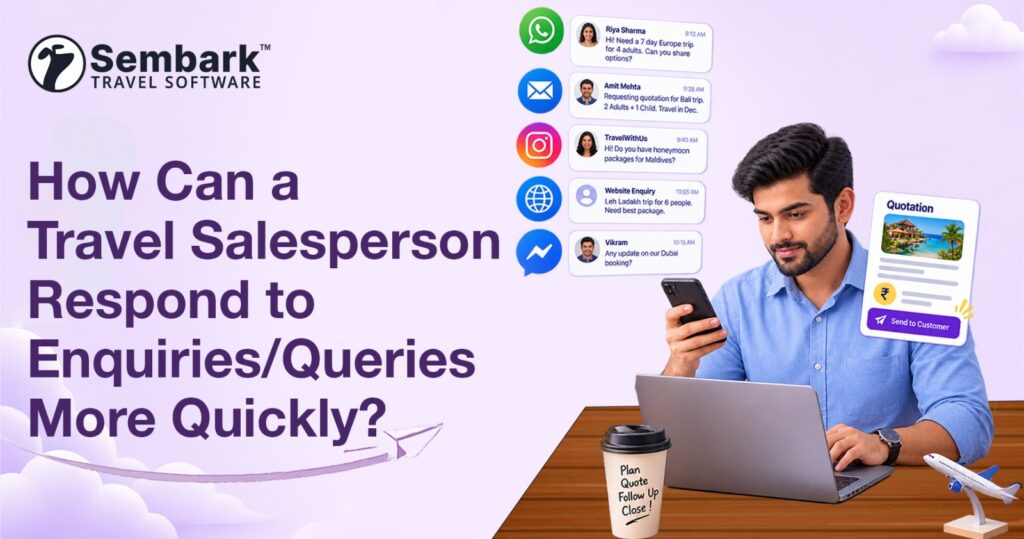
Before we start, I want you to meet Rahul, an overloaded salesperson working at a travel company.
Rahul walks into the office on a typical Monday morning. He is new to the travel industry, but he is serious about doing well.
By 9:30, he already has:
- 5 new enquiries on WhatsApp
- 3 emails asking for quotations
- 2 customers asking, “Any update?”
- A supplier waiting for guest details to book hotels
- A new agent asking for the best possible rate
Rahul knows he needs to respond quickly. But he also needs to check hotels, transfers, sightseeing and prices before he can give the right answer. Inbound tour operators know this well; agent enquiries always come with rate and ground checks attached.
Then another enquiry comes in.
And another.
By 11 AM, Rahul isn’t struggling to find customers. He is struggling to keep up with them.
This isn’t because Rahul isn’t good at sales. It’s because most of his day disappears into reading emails, copying customer details, checking hotel rates, making changes to quotations, and juggling multiple apps and Excel sheets.
This is a common Monday morning in a small travel company. And it raises an important question:
How can a travel salesperson respond to enquiries faster without compromising on the quality of the response?
The reality is that many travel salespeople spend more time managing enquiries than actually selling.
And when I say many, I mean many, not all.
What’s Slowing Down Your Response Time?
Let’s look at Rahul’s day a little more closely so you can understand where things get stuck.
The biggest problem usually isn’t the number of enquiries. It’s the amount of manual work between receiving an enquiry and sending a useful response.
For many travel businesses, these steps have simply become part of the normal way of working.
But they can quietly slow down the entire sales process. Slow response is one of the 10 operational challenges travel operators face.
1. Enquiries are coming from everywhere
Rahul’s travel agency receives enquiries from WhatsApp, email, Meta, the website, and sometimes even walk-ins.
The problem is that these enquiries aren’t always captured in one place.
Rahul has to keep checking different platforms just to find out who needs a response.
2. Customer information has to be entered manually
Name, destination, travel dates, number of travellers, hotel preference, budget…
Before preparing a quotation, Rahul may spend 15 minutes or more just collecting and entering enquiry details.
He copies information from an email or WhatsApp message into Excel or another system, and then starts preparing the quotation.
This also creates room for mistakes, such as incorrect costing, missing customer details, or missed requirements.
3. Building a quotation can take 30 minutes or more
Once Rahul understands what the customer wants, he has to check multiple rate sheets, hotel rates, transport costs and activity suppliers.
Then he calculates markups and taxes before preparing the quotation.
While he is doing all of this, another salesperson may already be responding to the same customer with a faster option. For global travel agents, the faster reply usually wins the booking.
4. Amendments keep interrupting new sales
According to Rahul, this is one of the biggest frustrations he faces every other day.
When he finally sits down to respond to a new lead, an existing client pops up:
- “Can you change the hotel?”
- “Can you add one more night?”
- “Can you send the revised quotation?”
The salesperson switches tasks again.
And the new enquiry waits.
4 Ways to Respond Faster to Travel Enquiries
These problems may be part of your current process. But as a travel business grows, these small manual tasks can start taking a significant amount of time away from sales.
The good news is that you don’t always need to completely change the way your team works.
Start by removing unnecessary steps from the process.
Here are four practical ways travel sales teams can improve their response time.
1. Capture every enquiry in one place
Don’t make salespeople search through WhatsApp, email, spreadsheets and website dashboards.
A proper travel enquiry management process should bring enquiries into one place so the salesperson can see what needs attention.
What changes after this?
Your team doesn’t start the day by hunting for enquiries. They can start by responding to them.
2. Simplify the quotation-building process
Salespeople shouldn’t have to recreate every quotation from scratch.
A system that keeps hotel rates, supplier contracts, transport costs, markups and taxes organised can significantly reduce the time required to prepare an itinerary and quotation.
What changes after this?
Instead of spending time collecting information and formatting a quotation, your sales team can spend more time actually speaking to customers.
3. Keep follow-ups visible
Responding quickly isn’t only about the first response.
A customer who receives a quotation today but doesn’t hear from the salesperson for three days can easily move on.
A proper follow-up system helps salespeople know:
- Who needs a follow-up?
- When should they follow up?
- What was discussed previously?
- Which quotation was shared?
What changes after this?
Fewer opportunities disappear simply because someone forgot to follow up.
4. Prioritise leads instead of treating every enquiry equally
Not every enquiry needs the same response time.
A customer travelling next week with a confirmed budget is very different from someone casually asking for prices for next year.
Sales teams should be able to identify urgent, high-intent enquiries and respond to them first.
What changes after this?
Even a simple tag such as “Hot Lead” or “High Intent” can help the team prioritise better.
It also means that if the salesperson handling an important enquiry is unavailable the next day, someone else can quickly understand which leads need attention.
How Can Technology Help?
Implementing these processes has become much easier with modern travel CRM software.
Earlier, managing leads effectively often meant using multiple tools for different tasks. Today, a travel CRM can bring many of these activities together in one place.
For example, Sembark Travel CRM helps travel businesses manage their lead process with features such as:
- AI Email Capture: Automatically reads and captures enquiries from emails. See how it works.
- API Integrations: Connect existing tools and platforms with Sembark.
- Auto Lead Capture & Distribution: Capture leads automatically and assign them to the right salesperson.
- Automated Follow-Ups: Schedule follow-ups so no lead is forgotten.
- Admin Control: Get visibility and control over leads, teams, assignments and activities.
- WhatsApp Transaction Automation: Automate customer updates, confirmations and transactional messages on WhatsApp.
- Real-Time Alerts: Get instant alerts for new leads, follow-ups, updates and important actions.
But lead management is only one part of the process. Not every tool handles that part equally, our best lead management software list shows the gaps.
Sembark also helps travel businesses build itineraries, create quotations, manage payments, coordinate suppliers and handle bookings within the same system. That is the complete workflow our DMC software covers.
The goal is simple:
Less time spent managing tools and more time spent selling.
Technology Is Becoming Part of the Travel Sales Process
Technology is no longer just about having another software tool.
It is about making everyday work easier, faster and more organised.
Think about how online banking changed the way we manage money. You no longer need to visit a bank for every small transaction. You use technology to make the process faster and easier.
The same shift is happening in the travel business.
Travel companies can now automate repetitive tasks, organise enquiries, improve follow-ups and manage daily operations with the right technology.
The question is no longer whether technology can help.
The question is how much time your sales team could get back by removing the manual work from their day.
Want to see how this can work for your travel business? Book a live demo with Sembark.
Related blogs