
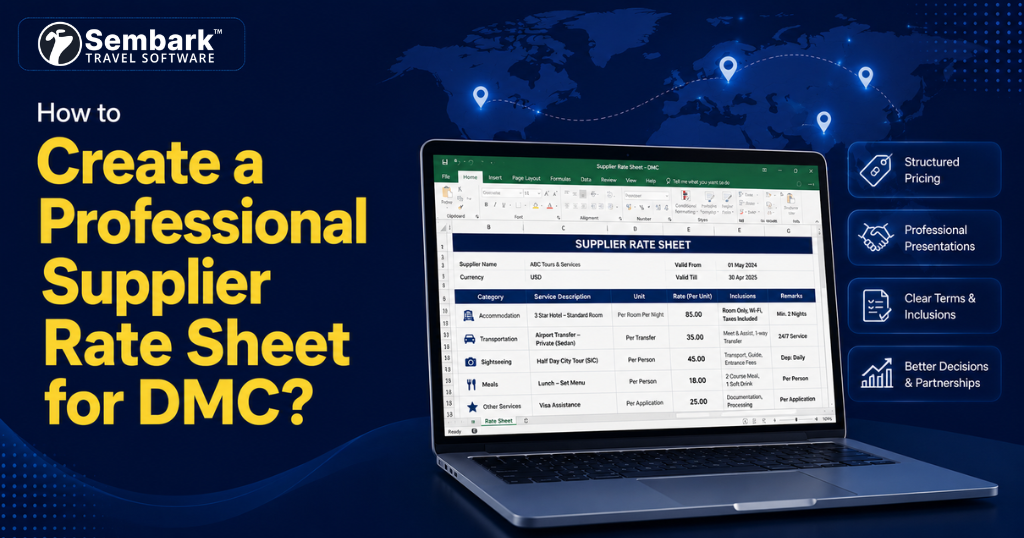
1. What is the Supplier Rate Sheet for DMC?
A supplier rate sheet for a Destination Management Company (DMC) is a master data/document or sheet used to store pricing details received from multiple travel suppliers/vendors such as hotel suppliers, transport suppliers, activity suppliers, guides, and other service partners in an organised way. DMCs use supplier rate sheets to calculate package costs, create accurate quotations, compare supplier pricing, & manage travel operations efficiently.
2. Why is Maintaining Suppliers’ Rate Sheets Professionally Important?
Suppliers’ coordination plays a vital role for DMC in delivering a smooth travel experience, but managing rates for hotel suppliers, transport suppliers, or activity suppliers in a scattered way becomes confusing to compare fairly & often leads to pricing errors.
Maintaining a professional supplier rate sheet format helps organise all supplier pricing more efficiently. It allows a DMC to execute the best method to price a travel itinerary faster, reduce operational mistakes, maintain consistency in quotations, and improve coordination between sales and operations teams..
Relatable Blog: Tour Booking Voucher For Travel Business (Word & PDF)
3. Key Elements for a Supplier’s Rate Sheet
3.1 Key elements in Hotel Suppliers Rate For DMC
1. Property Details
- Hotel Name
- Destination
- Star Category
- Amenities
2. Room type & Occupancy
- Room Type
- Occupancy
- Extra Bed
3. Season-wise rates
- Peak season
- High season
- Low season
- Super peak
4. Inclusions
- Meal Plan
- Special inclusions
5. Policy
- Min Stay
- Child Policy
- Cancellation Policy
- Stop-sell / Blackout Dates
Free Download Hotel Suppliers Rate Sheet Template: Click Here
3.2 Key elements in Transport Rate Sheet For DMC
- Route/Transfer
- Vehicle Type
- Private / SIC
- Capacity (Pax)
- One Way
- Round Trip
- Per Day
- Night Charges
- Toll/Parking
- Driver Allowances
- Remarks
Free Download Transport Suppliers Rate Sheet Template: Click Here
3.3 Key elements in Activity Rate Sheet For DMC
- Activity Name
- Category
- Duration
- Adult Rate
- Child Rate
- Min Pax
- Inclusions
- Important Notes
- Close Dates
- Slots
Free Download Activity Suppliers Rate Sheet Template: Click Here
4. How to Build a Supplier’s Rate Sheet (step-by-step explanation)
Step 1: Collect Information
Start by gathering all suppliers’ pricing details from hotel suppliers, transport suppliers, & activity suppliers. Importantly, you need to collect:
- Contracted rates
- Seasonal pricing
- Cancellation terms
- Validity dates
- Inclusions and exclusions
Step 2: Standardise a Format
Create one standard structure for each supplier. Every hotel supplier, transport supplier, or activity supplier follows the same layout..
Step 3: Categorise by Destination & Supplier Type
Now you have to separate rate sheets according to destinations, team or supplier categories. This makes searching & updating information much easier for operations teams in the long term. Plus helps in making quotations fast.
Step 4: Add Validity & Seasonal Segmentation
Travel pricing changes frequently. To avoid quoting expired pricing, always divide rates into:
- Peak season
- Off-season
- Festive season
- Long weekends
Step 5: Add Operational Notes
This may include:
- Preferred suppliers
- Supplier response time
- Emergency contacts
- Payment terms
- Service quality remarks
Step 6: Update Rates Regularly
Make sure to update the rate sheets monthly or quarterly. An outdated rate sheet can lead to incorrect quotations and financial losses.
5. Common Mistakes to Avoid
Many travel businesses create supplier sheets but fail to maintain them properly. Common mistakes include:
- Using different format every time of updating sheet
- Missing validity dates of the contracts
- Not updating seasonal pricing & weekend pricing in sheet
- Doing manual calculations without using formulas
- Duplicate supplier entries
- Multiple team members updating the sheet without any history
- Storing files in multiple locations
Best Platforms You Can Use to Create a Supplier Rate Sheet
Choosing the right platform for managing supplier rate sheets depends on the size of your travel business, the number of suppliers you manage, and how frequently your pricing changes. Different tools offer different levels of flexibility, automation, and collaboration.
1. Microsoft Excel or Google Sheets
Why is it used:
It is the most common platform used by travel businesses for maintaining supplier rate sheets as it is easy to use, affordable, flexible, & supports formulas for costing calculations.
Major Cons:
Manual data entry, higher chances of pricing errors, duplicate versions, & lack of data control, which creates difficulty in managing large supplier databases.
2. Airtable
Why is it used:
Provides a structured database-style system with filters, automation, attachments, & collaboration features, making supplier management more organised.
Cons:
It is very complicated for non-technical teams & it is also time-consuming if you want to build a customised workflow for your business.
3. Notion
Why is it used:
Helpful for maintaining supplier records, contracts, policies, & operational notes in one centralised workspace.
Cons:
Limited for automated calculations, increasing risk of pricing errors.
How are Travel CRM like Sembark transforming Supplier Rate Sheet Management?
But if your team still chooses to manage supplier rate sheets on Excel, WhatsApp, and scattered PDFs, you’ll probably be spending more time fixing errors than actually selling packages.
Globally, travel businesses are shifting to travel CRM platforms like Sembark because this is exactly where a Travel CRM makes a difference. It not only centralises supplier rates but automates costing, & streamles quotation workflows. This is saving travel businesses from hours of manual work every single day while improving their conversion rate.
And the best part? Your sales team responds faster, operations stay aligned, and clients receive professional quotations in minutes instead of hours.
If your business is growing and handling multiple customised itineraries daily, it may be the right time to move beyond spreadsheets.
Read More: