It’s 2026, and the world is witnessing the travel industry’s biggest revolution. Between the pandemic recovery and the AI boom, everything shifted. Travellers have become smarter, their expectations have risen, and the best travel businesses have embraced every bit of that change.
But still, many travel businesses are managing their operations on Emails, Excel sheets, WhatsApp threads, and sticky notes, and slowly becoming part of a minority that struggles for their existence and to stay relevant every single year.
Let’s understand with a small example: two travel agencies sell the same Kashmir itinerary. One responds to all enquiries in minutes, sends personalized branded quotations, tracks every payment, and never misses a follow-up. The other remains busy searching for the correct Excel files and copying & pasting everything one by one, and spends hours on just one customer. Same Product, but very different operating style, and what separates them is “Software”.
The businesses that are growing at an exponential rate right now are not necessarily the ones that have the lowest prices or the most exotic destinations. They are the ones with the most efficient and effective systems.
This is why we have put this blog together. At Sembark, we have spent a lot of time finding & understanding how travel businesses operate, what helps them scale, and what slows them down.
So we tracked down every primary source, went through stacks of reports, and compiled everything in one place: market sizes, regional data, adoption rates, category-by-category breakdowns, and trends shaping 2025-2026.
Travel Agency & Tour Operator Software: Market Size, Analysis & Statistics
The real statistics behind the shifts undergoing in the travel industry are hard to ignore. What was once just a scattered mix of basic Microsoft tools and spreadsheets has turned into a multi-billion-dollar industry, and it is still just in its early innings. Let’s make you believe by showing you the actual figures:
Tour Operator Software
The Tour Operator Software Market has grown rapidly over the past few years.
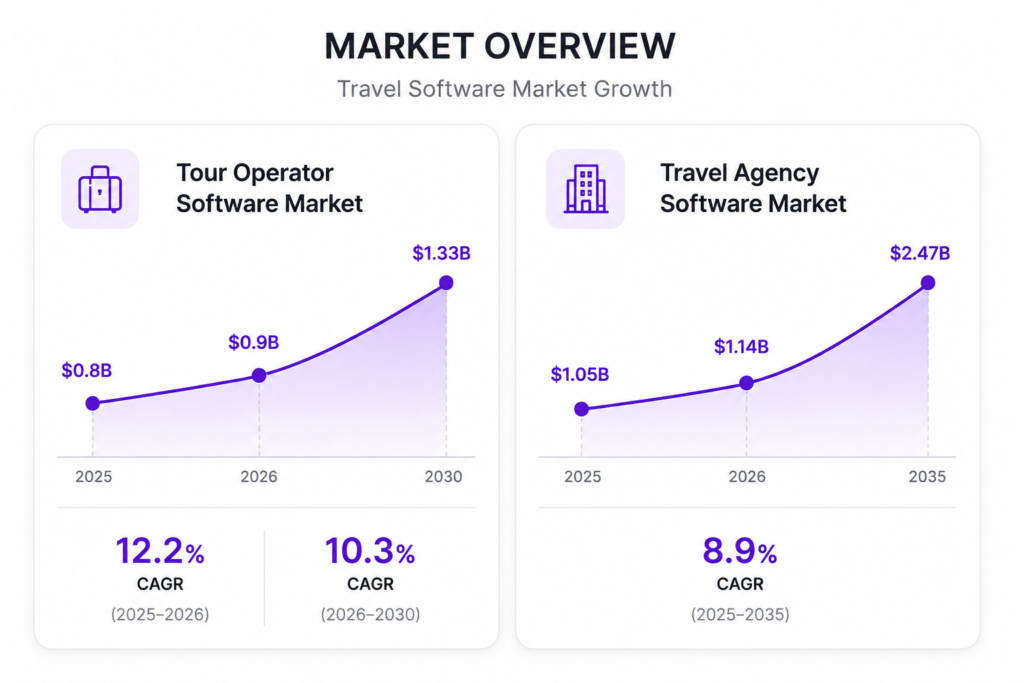
- The global tour operator software market is growing from $0.8 billion in 2025 to $0.9 billion in 2026 at a CAGR of 12.2%, and is expected to hit $1.33 billion by 2030 with a CAGR of 10.3%.
- The factors that drive this growth are: growing adoption of AI-driven itinerary planning, rising demand for personalised trips, increasing payment gateway-related integration, expansion of mobile-first platforms, and higher focus on real-time customer engagement.
Source: Tour Operator Software Market Size, Share & Forecast to 2030
- When we look at the ground operations, the shift is already well underway, as more than 68% of travel operators have already ditched manual booking systems for automated platforms, approximately 72% of global tour reservations are now processed through digital channels, nearly 61% use integrated itinerary management tools, and 54% have real-time inventory sync in place.
Source: Tour Operator Software Market Size & Forecast [2035]
- Tour operators and DMCs make up for 55.1% of the market, emphasising their reliance on digital tools for handling their complex travel operations and large customer base, while SMEs are leading the adoption of SaaS-based platforms at 80.6%, to streamline their operations and enhance competitiveness.
These statistics are a sign of just how deeply digital transformation has taken hold across the industry.
Travel Agency Software
The Global Travel Agency Software market tells an equally compelling story; it is a market that is highly driven by rising digital adoption and, in recent years, has shown that there is a need for effective travel management solutions for achieving steady growth.
- The market that was valued at $1051.24 millions in 2025 has now grown to $1144.81 millions in 2026, and is expected to reach around $2465.94 million in 2035 with a CAGR of 8.9%.
Source: Travel Agency Software Market Size & Analysis 2035
- This switch is being driven by travellers themselves as most of the modern travellers now prefer personalised travel experiences, and there is a rising demand for digital and online booking solutions, pushing travel agencies to adopt cloud-based software with dynamic pricing, itinerary management tools, and customised offers.
Source: Travel Agency Software Market Report: Size, Growth, Trends & Forecast (2025–2033)
These statistics are a sign of just how deeply digital transformation has taken hold across the industry. As the travellers continue to raise the bar, travel businesses such as Tour Operators and Travel Agencies have no choice but to meet it, and adopting software is how they are doing it.
Now let’s look at exactly the different categories of software that are used by travel agencies and tour operators, and what kind of shift they drive.
Software Categories Used by Travel Agencies & Tour Operators
A modern travel business does not run on just one tool; it runs on a carefully assembled stack of 4-7 different software systems. Each category plays a unique role in keeping travel business efficient, competitive, and scalable. Here are 6 categories that matter most, with separate market data for each.
- Travel CRM
What It Is: A Travel CRM is the operational backbone of a travel business. It manages the entire customer journey, from the first enquiry to the final booking confirmation, handling quotations, managing follow-ups, supplier records, payment tracking, and everything in between, all in one centralised platform.
Sembark is one such Travel CRM that is exclusively built for DMCs, Tour Operators, Hotel Resellers, and Travel Agencies. From API lead integration, smart follow-up reminders, to smart tour calendar, supplier management, real-time payment tracking, and MIS & Analytics Reports, it brings all of this together in one connected place. Sembark Travel Management Software is trusted across 28+ countries with a Google rating of 4.9/5. We’ve compared how different platforms handle this in our breakdown of the best lead management software for tour operators.
Stats:
- The CRM market built exclusively for travel businesses reached $1.32 billion in 2024 and is set to grow at a CAGR of 12.1%, nearly reaching $3.67 billion by 2033. This remarkable growth is primarily driven by an accelerating shift towards cloud adoption, personalised customer engagement, and automation across the travel industry.
Source: Tour Operator CRM Market Research Report 2033
- Travel businesses that use a dedicated Travel CRM across sales, accounts management, and customer service are more likely to retain over 50% of their customers than businesses that limit CRM use to sales only.
Source: TravelOperations – State of Travel Agency Operations 2025
- Approximately 74% of travellers now prefer personalised travel experiences, making CRM a platform that handles follow-up automation, dynamic pricing, and customer preference tracking, less of a choice and more of a necessity.
Source: Travel Agency Software Market Report: Size, Growth, Trends & Forecast (2025–2033)
- Online Booking Engines
What It Is: An Online Booking Engine is the technology that sits behind your “Book Now” button. It processes real-time availability, pricing, and confirmations directly on the businesses’ website or partner channels, without any manual intervention. Examples: FareHarbour, Peek Pro, Rezdy, and Checkfront.
Stats:
- The Global Online Booking Systems market, which was valued at $13.8 billion in 2025, is projected to grow at a CAGR of 9.7% and reach $31.6 billion by 2034.
Source: Online Booking Systems Market Research Report 2034
- The booking engine software segment already commands 38.7% share of the global OTA Software market, which itself is expected to grow from $3.2 billion in 2024 to $13.5 billion by 2034. This growth reflects strong demand for integrated platforms that streamline reservations and improve conversion rates for travel service providers.
Source: Online Travel Agencies Software Market Size | CAGR of 15%
Most of the modern travellers, especially Millennials and Gen Z, consider online booking essential. So, if your customers have already decided on its significance. The only question that remains is whether your software is ready for them or not.
- Global Distribution Systems (GDS)
What It Is: A GDS is an invisible infrastructure of the travel industry, a computerised network that centralises data and grants easier access to crucial information to travel service providers such as hotels, airlines, car rentals, and other travel services worldwide. Examples: Amadeus, Sabre, and Travelport.
Stats:
- From $5.8 billion in 2024 to a projected figure of $12.3 billion by 2033, the GDS market size is growing at a robust CAGR of 8.5% over the forecasted period.
Source: Global Distribution System Market Research Report 2033
- Over 70% of global airline reservations are processed through GDS systems such as Amadeus, Sabre, and Travelport.
Source: Distribution System Market Size & Growth Report, 2035
- Hotel Channel Managers
What It Is: Hotel channel management software, also known as a channel manager, is a specialised platform that enables hoteliers to efficiently distribute room inventory across multiple online booking channels. These solutions help maximise occupancy while reducing overbooking risks. Examples: SiteMinder, Cloudbeds, and RateGain.
Stats:
- The global hotel channel management software market was valued at $1.8 billion in 2025 and is projected to reach $4.2 billion by 2034, expanding at a compound annual growth rate (CAGR) of 9.8%.
Source: Hotel Channel Management Software Market Research Report 2034
- Cloud-based solutions management alone accounts for 71.3% of total market revenues in 2025, and is expected to grow with a CAGR of 11.2% through 2034, leaving on-premises alternatives far behind.
Source: Hotel Channel Management Software Market Research Report 2034
- Itinerary Builders & Proposal Tools
What It Is: An itinerary builder is a tool that turns a travel idea into a branded, polished proposal or quotations, to allow travel businesses to visually build, customise, and share day-to-day plans with clients in a format that is attractive as well as professional enough to close the booking. Examples: Travefy, Ezus, TravelJoy, and PlanItEasy.
Read more on what a travel itinerary builder does and why travel businesses use one.
Stats:
- The Travel Arrangement Software market, which includes Itinerary Builder and Proposal Tools, was valued at $8.5 billion in 2024 and is estimated to reach $15.2 billion by 2033, growing at a CAGR of 7.3% from 2026 to 2033.
Source: Travel Arrangement Software Market Size, Share & Forecast
- Nearly 61% of tour companies use an integrated Itinerary Management Tool, which highlights the fact that if you are still building proposals using Canva, Word, or online templates, you are behind the majority of your competitors and should know what to look for in a tour operator itinerary tool before you switch.
Source: Tour Operator Software Market Size & Forecast [2035]
In this era of AI, the majority of travellers are using AI tools like Claude, ChatGPT, and Gemini to plan their own trips, and because of this, travel brands are pushing themselves to invest in AI-powered itinerary capabilities to stay competitive. We’ve also compared the top Ezus alternatives for DMCs and tour operators in a separate blog.
- Travel & Expense Management Software (Corporate Travel)
What It Is: Travel & Expense Management software is developed to automate and manage how corporate travel is booked, approved, and reimbursed, giving corporate travel teams full control over budget tracking, expense reporting, and policy compliance, which would have otherwise required significant manual effort. Example: SAP Concur, TravelPerk, Navan, and Rydoo.
Stats:
- From $4.08 billion in 2025 to $12.98 billion by 2034, the global travel and expense management software market is growing at a CAGR of 13.80%, one of the fastest in the entire travel tech space.
Source: Travel and Expense Management Software Market Growth, 2034
- While the corporate travel management software market has been witnessing robust growth, with its value predicted to expand from $1.17 billion in 2025 to $1.26 billion in 2026, at a CAGR of 7.5%, it is expected to reach $1.66 billion by 2030.
Source: Corporate Travel Management Software Market Report
- With 76% of global enterprises prioritising real-time expense tracking and policy compliance, CRM and ERP integrations have become indispensable to how modern corporate travel programs actually run.
Source: Corporate Travel Management (CTM) Software Market Size & Industry Analysis [2035]
More than 70% of corporate travel buyers have seen an increase in business travel bookings, while 72% of travel managers and travellers expect to take more business trips in 2025 than in 2024.
Travel Software Global Regional Usage & Market Share
Now that you know about different categories of software that are used by travel businesses, here is a little brief about where in the world they are being adopted, and where the next wave of growth will be coming from.
North America
- It was known as the largest region in the travel management software market in 2025, as it is driven by high digital adoption, robust technological infrastructure, and a dense concentration of major travel technology providers.
Source: Travel Management Software Global Market Report 2026
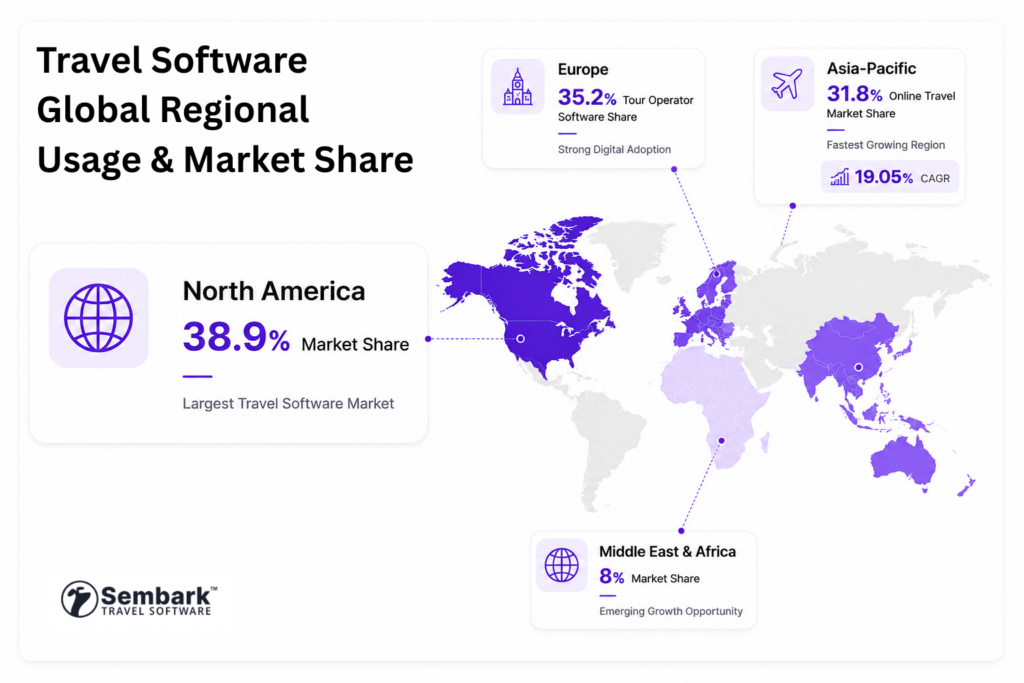
- With a 38.90% share of the global travel and expense management software market in 2025, North America is not just leading, it is defining the benchmark that all other regions are chasing.
Source: Corporate Travel Management Software Market Report 2026
Europe
- Europe represents 35.2% of the global tour operator software market, a market that is built on decades of strong tourism infrastructure and driven by advanced digital adoption across the region.
- Cloud integration in this region has been vital for maintaining customer engagement across online travel platforms and traditional agencies, with Germany alone reaching about 45.79 million in market value, with an estimated CAGR of 8.5%, a small but significant indicator to highlight Europe’s digital depth.
Source: Tour Operator Software Market Size | CAGR of 10.9%
Asia-Pacific
This one is worth watching closely, and for Indian travel businesses especially, these figures should be hard to ignore.
- Known as the fastest-growing region, the Asia-Pacific accounted for the largest share of 31.8% of the Global Online Travel Market just in 2025, as it is highly driven by rapid internet adoption, smartphone usage, and digital transactions.
Source: Online Travel Market Size, Share, Growth & Forecast 2034
- Asia-Pacific is projected to grow at the highest CAGR of 19.05% through 2031 in travel and expense management software, as China, India, and Japan are heavily investing in cloud infrastructures and digital payments.
Source: Travel and Expense Management Software Market Size & Share Analysis, 2031
- India, in particular, sits at the center of this fast-paced growth, as it is one of the world’s largest and fastest-growing travel markets, a mobile-first traveler base, and a rapidly expanding base for tour operators and DMCs who are adopting digital tools to compete.
Africa and The Middle East
- These are the regions that are at an early stage but moving fast. They are witnessing rising adoption of digital travel systems as businesses are starting to shift towards modernised expense management and automated booking tools.
- The Middle East and Africa represented 8% of the Travel Management Software market in 2026, as well as cloud infrastructure growth, which is expected to accelerate more across both regions, reflecting emerging opportunities in corporate travel modernisation.
Source: Travel Management Software Market Size | Global Forecast To 2035
Across every region, whether it’s an already developed region like North America and Europe, a fast-growing region like Asia-Pacific, or an emerging region like Africa and Middle East, the direction is the same: Rising Adoption of Travel Management Software, which is going higher every year.
So the question now is no longer whether your region is going digital, it is whether your business is keeping up with it or not.
Key Software Trends Shaping the Travel Agency and Tour Operator Industry 2025-2026
- AI Is Not Just A Feature, It Is The Future
In recent years, “AI-powered” was used as a marketing line, but today it is an operational reality that is reshaping how every part of travel businesses runs.
- The AI in the travel market has grown exponentially in recent years. It will grow from $165.93 billion in 2025 to $222.4 billion in 2026 at a compound annual growth rate (CAGR) of 34%, as it is driven by the expansion of online booking platforms, digital customer service, and rising cloud adoption.
Source: Artificial Intelligence (AI) in Travel Market Report 2026
- According to McKinsey’s joint report 2025 on Remapping Travel with Agentic AI in travel, funding for AI-enabled companies spiked from 10% in 2023 to 45% by mid-2025, with most companies using AI reporting over 6% annual revenue growth and cost savings.
Source: The future of agentic AI in travel and hospitality | McKinsey
- Cloud Is Not A Thing Of Future, It Is Already The Present
When the world’s biggest travel businesses are going all-in on Cloud and AI, it is not just a gamble; it is a direction.
- Over 64% of new travel technology implementations globally in 2025 choose cloud or hybrid deployment models, compared to just 38% in 2020.
Source: Travel Technology Market Research Report 2034
- The cloud is the fastest-growing segment within the travel technology market, as it is driven by continued investment in cloud-native SaaS solutions, and projected to expand at a CAGR of 13.1% from 2026 to 2034. So every major travel platform is building its future on it.
Source: Travel Technology Market Research Report 2034
- Mobile-First is Non-Negotiable
Nowadays, if your software does not work on a phone, you are already behind. And in a market like India, where mobile is the primary device for most of the population, you are invisible.
- In 2026, mobile dominance has surged, as over 68% of travel searches now originate on mobile devices, and mobile platforms account for approximately 63% of all online travel bookings globally.
Source: Online Travel Booking Statistics 2026 – TRAppe
- Nearly 40% of global travelers have already used AI-based tools and platforms to plan their trips, and 62% are open to using them in the future, prompting every travel business to invest in smarter, more personalised digital experiences.
Source: When machine meets wanderlust: The role AI plays in tourism | Kantar
- Enterprise-Grade Tools In Reach of Small Operators
Arguably, it is one of the most important shifts for most travel businesses, as small operators everywhere in the world are finally getting tools that were once reserved for large enterprises.
- Small and medium enterprises (SMEs) now lead the tour operator software market with an 80.6% adoption share, as more agencies and operators rapidly move towards SaaS-based travel platforms.
Source: Tour Operator Software Market Size | CAGR of 10.9%
- Small travel operators are increasingly adopting AI and cloud-based tools, as these technologies help improve operational efficiency, reduce manual workload, and scale business operations without building large teams.
Source: The future of agentic AI in travel and hospitality | McKinsey
- Corporate Travel Is Growing and Going Fully Digital
The question of whether corporate travel would return has already been answered. Now the focus is entirely on how effectively travel businesses can manage, automate, and scale it.
- Approximately 48% of global travel buyers expect their companies to increase corporate travel in 2025, while 57% of them expect higher spending related to business travel, signaling that corporate travel is not just recovering, it is also accelerating.
- Budget for corporate travel is on the rise since 2025, but so is the complexity of managing them, and the global travel and expense management software market, which is growing at a CAGR of 13.80%, reflects exactly how organisations are responding to it.
Source: Annual Study Reveals Complexity of Business Travel in 2025 | SAP Concur US
Conclusion
All the information and statistics provided in this blog point towards one conclusion: Travel Software is no longer just a back-office investment; it has become the backbone, and a competitive advantage of every travel business that wants to grow in 2026 and beyond.
Technologies like AI and Cloud have now become the default, mobile and internet are driving the majority of the bookings, and the tools that were once only reserved for large enterprises are now within the reach of every travel business anywhere in the world.
The gap between businesses that are running on efficient software and those that are still copy-pasting manually is widening day by day.
The ones with the right system will continue to grow faster, convert better, and deliver experiences that will keep making customers come back. And the ones without will just spend more money and time managing an endless loop of chaos.
The shift has already happened. Now, the only thing left to do is to decide which side of it you want your business to be on.
If your travel business still runs on excel sheets, whatsapp threads, and manual follow-ups, you already know which side you are on, and Sembark Travel Management Software was built specifically to change that, and move you to the other side.
Book a Demo and see what the right system looks like in practice.