Do you remember that night in traffic after office, thinking about cooking something, but at the red signal, you got lost in a 200-rupee discount billboard for Zomato and ended up ordering food from Zomato.
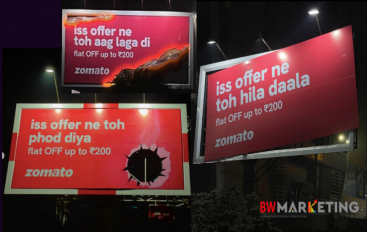
Image source: Google
That is because the billboard, a branding asset of ZOMATO, succeeded to:
Grab Attention → Create Interest → Drive Recall → Enforce Action
Now, when it comes to event branding typically serves three purposes:
- Attract: Pull people toward your stall (booth design)
- Explain: Clarify what you do and why it matters (brochures)
- Recall: Help them remember you after the event (visiting cards)
| 1. Booth: Your Physical Brand Experience |
| 1.1. Include Booth Position |
| 1.2 Booth Design Strategy |
| 1.3 Booth Dimensions |
| 1.4 Content Framing |
| 1.5 Images, Vectors & Infographics |
| 1.6 Rules, Mistakes & Tips |
| 1.7 Fabrication |
| 2. Brochures: Turning Interest into Understanding |
| 2.1 Brochures Design Strategy |
| 2.2 Key Design Rules |
| 2.3 Mistakes To Avoid |
| 2.4 Pro Tips |
| 3. Visiting Cards: Small Asset, Big Recall Value |
| 3.1 Visiting Card Design Strategy |
| 3.2 Rules, Mistakes & Tips |
This blog is a practical planning guide to help you design, fabricate, print, and deploy event branding assets that actually deliver business value.
1. Booth: Your Physical Brand Experience
Your booth is not just a structure. It is your first impression and one of the most powerful brand touch points at an event. People engage with your brand through a physical experience that you set up at an event.
Include Booth Position
While booth selection often happens early in the planning phase, the location of your booth is the foundation of your physical presence.
- Preferred Layouts: Prioritise Island stalls (open on all sides) or 2-side open plots; if using a 3-side closed shell, ensure the front has high impact.
- Shared & Pavilion Spaces: Choose shared table spaces for lean & minimalist setup, or join Destination/Association Pavilions to benefit from their larger footprint.
- Traffic Strategy: Always prefer spots at Multiple Cross-Junctions to capture the highest volume of natural foot traffic.
- Strategic Placement: Avoid locations near toilets or food court entries to ensure you attract quality engagement rather than a distracted crowd.
Booth Design Strategy
- This one simple rule: your booth design should be instantly clear. It should take a few seconds to understand who you are, what you do, & why they should be interested.
- Remember, do not try to communicate everything you provide. Decide and prioritise the problems that would attract the visitors who are your target audience.
What will add value for them? And then design your booths around that theme. - Support your logo with the message you want to convey. For example, if there is a specific problem, a specific solution or a specific pain point that will help you get maximum attention around it.
- All the details in the booth should complement each other and not compete with each other
Booth Dimensions
- It is the most crucial part of your design to lock the dimensions at first. Height,
depth, and width, know exactly how the layout will be in reality. - It is important that your design is created for scaling and not adjusting later. A layout
that works in a 3×3 m booth is not compatible with a 2×2 m booth. - Theme: prefix colour, branding, and font theme
- Before starting with the design panels, it is important to decide on your visual theme. If you already have your brand colours or a font, make sure that your booth follows it.
Content Framing
Content is essential instead of writing a paragraph in the booth. Keep things crisp and easy to read: Catchy headlines, Short 1-sentence sublines and Strong CTA
Images, Vectors & Infographics
Visuals in a booth are not decorations; they are used to support understanding
- Prefer vectors, icons, & simple infographics
- Use images only if they add a certain meaning
- All images should be in high-resolution, i.e. minimum 300 DPI (Avoid stock photos
that do not relate to your offering)
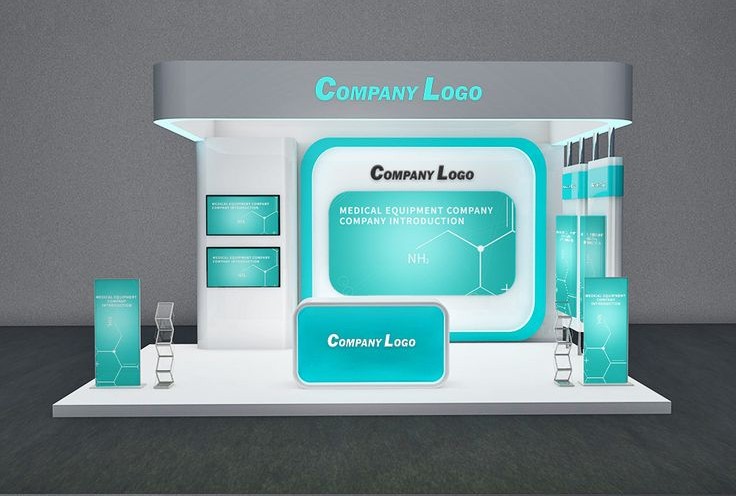
Booth Layout Ideas : https://in.pinterest.com/pin/120189883799454620/
Rules, Mistakes & Tips
| Colour | There should be a maximum of 3 brand colours used in the booth |
| Font | Finalise 2 fonts at max, one primary font & second supporting font |
| Logo | Maintain consistency in logo placement: do not experiment panel to panel. Ensure that your logo placement is consistent across all panels. |
| Mistakes to avoid | Tips |
| Spelling or grammar errors (always proofread) | Keep text minimal, remember “Booths Are Scanned, Not Read” |
| Low-quality or pixelated images | Maintain breathing space in the design, but avoid large empty panels |
| Too many messages are competing for attention | Use colour selectively to guide attention |
| Designing panels like brochures | Create clear font hierarchy: headline → subtext → support |
Fabrication
Usually, the booth fabrication is handled by the event organisers, as they use standard materials for all exhibitors. You only need to provide the design based on the booth size and blueprint shared by the event team, and the setup is done accordingly.
However, at some events, exhibitors are required to arrange their own fabrication. In such cases, you’ll need to find a local fabrication partner. Most fabrication companies across events generally work with similar materials, regardless of the type of exhibition.
And in case you are reading this for OTM 2026 or SATTE 2026, let’s make things easy for you.
Booth Fabrication Companies in Delhi for SATTE 2026
| Company | Contact Info. | Website Link | |
| Stall Designs– Exhibition Stalls & Booth Fabrication | +91-97111-55034 | sales@stalldesigns.com | Exhibition Stall Design Company | Booth Fabrication Experts |
| LeafyLane | Whatsapp: +91-888-262-6168 | info@leafylanedesign.in | Exhibition Stall Designer in Delhi, India | Stall Design Company |
| Design Bullz | +91 95402 40200 | contact@designbullz.com | Custom Exhibition Stands in Delhi | Best Exhibition Stall Designer |
Note: The fabrication company contacts shared here are for reference purposes only. Please conduct your own due diligence, verify credentials, review past work, and finalise vendors based on your specific requirements.
2. Brochures: Turning Interest into Understanding
Coming next to the brochures, once your booth has got the attention brochure works on explaining details. Unlike booth & visiting cards, your company’s brochure carries information. You can add all the required details about the products or services you sell in this material.
Brochures Design Strategy
| Theme | Colour, Branding, Font theme should be fix and maintain the same brand theme similar to the booth |
| Colour | Maximum 3 brand colours (maintain consistency) |
| Font | Maximum 2 fonts (i.e. one for headings, one for body text) |
| Logo | Consistent logo placement & brand tone |
If you have visual continuity, it will help visitors instantly connect the brochure
a- Text & Content Handling: Brochures provide detailed information, but they must remain easy to read:
- Still avoid big paragraphs with no breaks in between
- Use short paragraphs and add information in bullet points
- Break content into clear, meaningful sections
- Remember to highlight key points instead of leaving long text blocks
- Divide information according to the context, i.e. pain points on one page, product/service walkthrough on another
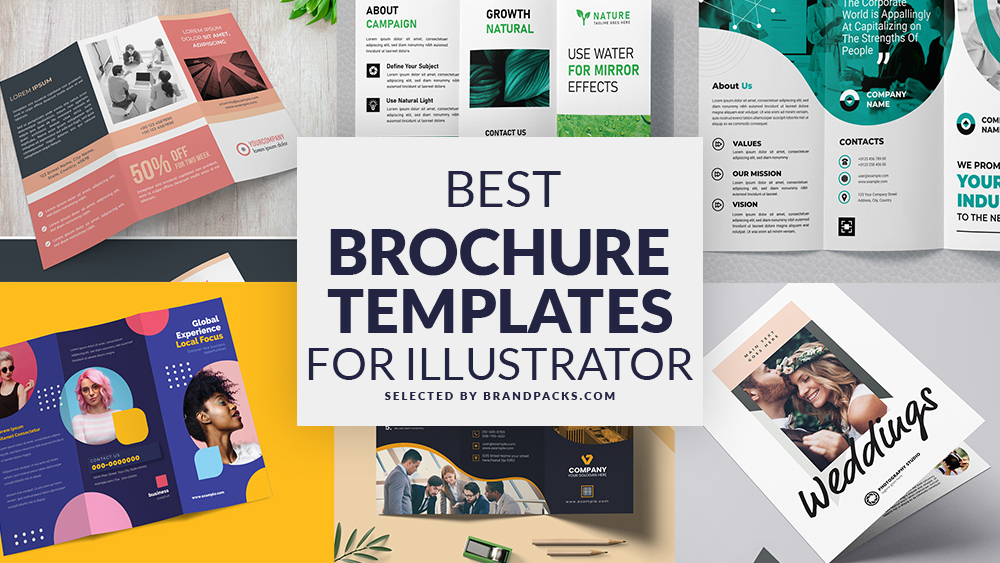
b- Layout Options: Layout can change based on size, content & purpose. Some layouts are:
| Bi-fold | Overview & quick explanation |
| Tri-fold | Structured storytelling or process flow |
| Multi-page booklet | Detailed solutions, features, or case studies |
c- Layout ideas: https://brandpacks.com/best-illustrator-brochure-templates/
d- Material Types & Paper GSM
- Matte finish: Premium, easy to read
- Glossy finish: Vibrant visuals but reflective
(Use 170–250 GSM for brochures; lighter paper feels cheap, heavier feels premium)
Key Design Rules
- Clear headline on the cover
- Logical content hierarchy
- Adequate spacing for comfortable reading
- Visual balance between text & graphics
- Use graphics for support
Mistakes To Avoid
- Too much text without breaks
- Small font sizes
- Poor paper quality
- No clear takeaway or call-to-action
Pro Tips
- Print fewer, higher-quality brochures
- Add QR codes linking to updated content or demos
3. Visiting Cards: Small Asset, Big Recall Value
So, be clear that the purpose of a visiting card is not used to explain anything, it is used to be remembered. Therefore, design should be minimal, clean, & aligned with your overall brand identity.
Visiting Card Design Strategy
a- Content
Include essential information only, including:
- Name
- Designation
- Contact details
- Company logo or brand mark
b- Colour Selection
Colours have to be catchy but controlled:
- It is better to stick with your brand palette
- High contrast between the background & text will improve readability
- Avoid too many shades
c- Layout
- There are commonly two orientations: Horizontal or Vertical (size remains standard)
- Front side: Has to be brand-focused (logo or visual)
- Back side: includes personal & contact details
- Corner cuts can be used sparingly to add uniqueness, but only if it aligns with brand tone
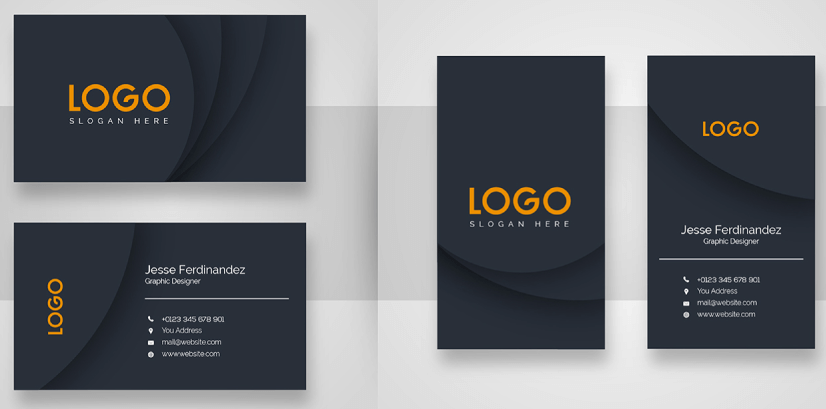
Visiting card design ideas: https://graphicmama.com/blog/free-business-card-templates/
d- Use of Images
If images are used, they must be professional and relevant. Abstract textures or subtle brand visuals work better than random photos. Avoid decorative images that add no meaning.
Rules, Mistakes & Tips
| Key Design Rules | Mistakes to avoid | Tips |
| Maintain ample white space for clarity | Too much text on a small surface | Carry different cards for different roles |
| Use consistent font styles with other brand assets | Low-quality or casual images | QR code linking to LinkedIn or a landing page |
| Ensure print margins and bleed areas are correct | Over-designed layouts that affect readability | Avoid folding or damaged cards |
4. Types of Printing
Choosing the right printing method significantly impacts both durability and perception.
Common printing types:
- Digital printing: Fast, small quantity
- Offset printing: Large quantity, premium finish
- UV printing: Durable, vibrant colours
- Screen printing: Speciality surfaces
Rule: Always match printing quality to brand positioning.
Final Thoughts
Branding for an event is not about standing out; it is more about attracting your target audience. Your design should be “UNDERSTOOD” & “REMEMBERED”. Plan it strategically, design with intention, fabricate smartly, & see your event investment delivering real returns.
Read More