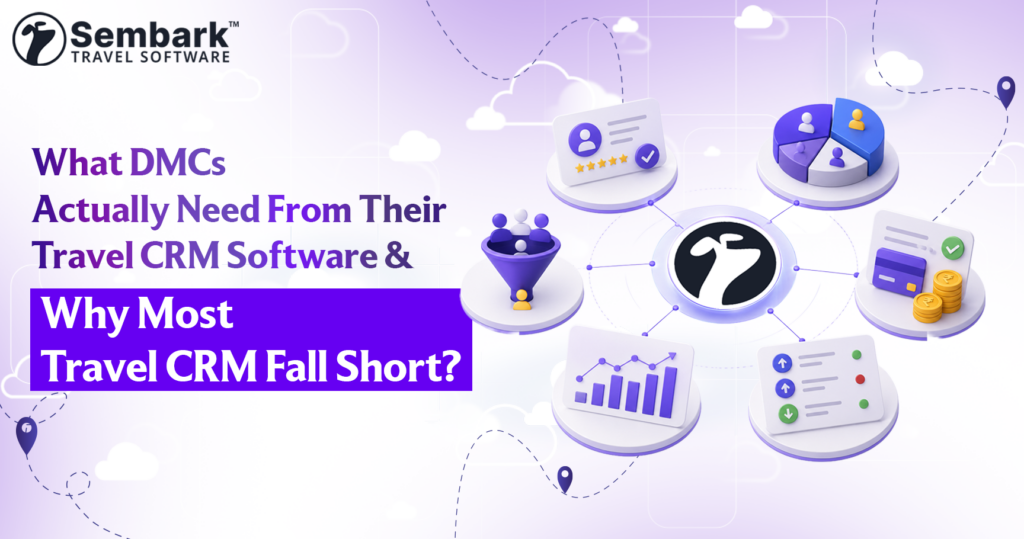
Hey DMC owner, tell me one thing: Is there an invoice in your inbox for a Travel CRM you purchased a few months ago?
It happens with a lot of DMC’s where they purchase a travel CRM in the hope that it will improve things for their business, but instead they end up going back to the tools they were using, with a higher cost of the yearly plan. For that year, the purchased CRM becomes just another application on your laptop, which was never used by the employees who were supposed to do more work with it.
1. Broken areas a DMC discovers after taking a travel software
While taking the demo and during the first few weeks, you feel excited that now things will change in your business. You start setting up the CRM, import your data, employees start getting trained, and it feels like everything will now slowly come under control.
But in a few weeks, challenges really begin. The employees are already resistant to new technology, and in training. They are unable to be productive. Queries are coming, but your employees are unable to use the CRM’s travel itinerary builder. Instead, they go back to their Excel sheet and calculator for preparing the quotations fast. In a few weeks, you also feel like, instead of pushing the employees, it is better to let them work on the old process and get your business going.
Let’s understand why & where DMCs actually feel the need for software.
2. For a DMC, purchasing travel software is like hiring a senior-level employee
After observing thousand plus DMC and their operations, what we have realised is that for DMC, it is not about purchasing software. It is about hiring a senior-level employee who can sort the three specific jobs perfectly for their travel business.
Create quotations easily, accurately & fast.
When an agent is sitting with a customer at a table, and your team takes two hours to respond, you know that the business is already gone. While your team is manually checking the cost, calculating hotel rates, margins & then replying to one query. It is like you are not paying your salesperson for converting trips, but only for using calculators, updating Excel sheets, and searching quotation templates. Therefore, it is the first and most important reason why DMC decides to purchase software.
Attending to leads on time
40% of the business in a DMC is lost because the leads are unattended when it is needed. The lead that arrives at 9 PM from an agent in Tier-2 city is answered the next morning. By then, some other DMC had already answered it. Lack of visibility for leads coming through multiple sources becomes the biggest bottleneck for your business, which you think a Travel CRM can solve.
Maintaining a healthy cash flow
For a DMC, they must have sufficient balance to complete the daily operations and don’t know what amount is pending and what needs to be paid. It is one of the problems due to which sometimes DMC ownershave to pull overnight, just to find out how they will manage the payments for the next week. This is because of the lack of visibility for the incoming payments, outgoing payments, and dues.
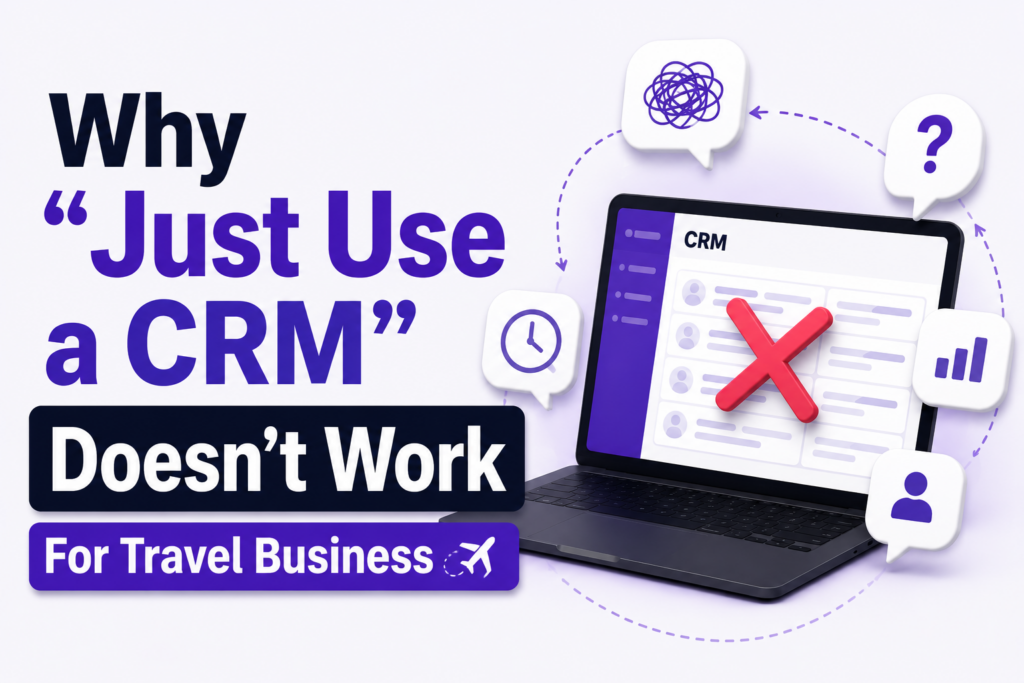
2.1 Why “Just Use a CRM” Doesn’t Work
During the demo, everything looks solved, but once you start running actual trips through it, the cracks show up fast. The CRM fails on the ground, and that happens because of the following reasons.
Lack of End-to-End Workflow: A generic Travel CRM is built to move a deal through a pipeline and stop the moment it’s manually marked as booked. It has no depth beyond that: no way to build the itinerary, cost it, assign suppliers, or run the trip. Everything that actually makes up a DMC’s work happens outside the software.
Only Built for Lead Capture: Most generic Travel CRMs, at their core, only have the capacity to capture the lead. Form fills, website visits, ad clicks, all logged neatly. But a DMC’s real work starts after the lead is captured, and that’s exactly where these tools stop being useful.
Inefficient Itinerary Creation Process (no markup flexibility, restricted amendments, limited format, fancy templates, confusing UI/UX): Basic itinerary builders in generic Travel CRMs aren’t built for real trip planning. There’s no markup flexibility component by component; amendments mean rebuilding from scratch, and the templates that do exist look nice but confuse the team more than they help.
Prone to Cost Calculation Errors: Costing stays manual, since these builders aren’t built to combine hotel rates, transport, activities, and taxes into one auto-calculated total. Margins get added by hand at the end, which leaves room for a missed rate sheet update, a small calculation slip, or a typing mistake. Any one of these can send out a quote with the wrong pricing, quietly eating into the margin on a deal that looks won.
No Built-in Supplier Management: Where a vendor module exists, it’s built for generic procurement, tracking a vendor’s contact details, products supplied, and purchase orders. There’s no season-wise rate structure and no ledger for advances or outstanding balances per booking, so tracking what’s owed to each hotel or transporter still happens outside the CRM.
Limited Reporting & Payment Tracking: These Travel CRMs report deal value and revenue, not what’s actually been collected. There’s no way to track instalments, due dates, or advances against a booking, and no visibility into which trips are actually profitable once ground costs are factored in. That entire picture stays outside the CRM.
None of this means the Travel CRM is broken. It’s doing exactly what it was built to do. The real issue is expecting a tool made for tracking leads and deals also to run a DMC’s day-to-day operations. A Travel CRM made to complete generic operations of a travel business is expected to handle the entire travel operation, which actually makes it difficult for your team to adapt to the new process. We’ve applied these same points while comparing the best alternatives to Ezus for DMCs and tour operators in a separate blog.
3. What “Built for DMCs” Should Actually Mean
It is very important to choose what is actually built for you. A travel-themed CRM would never help you do the job. 1200+ DMCs admitted that the outdated system or Travel CRM they were using lacked a proper understanding of their business, unlike Sembark, which exactly matched their operations.
Sembark travel CRM is built to do the real job for a DMC. It works as your best employee without taking leave 24/7. By choosing sembark, you are not just purchasing software that will burden your employees, but we have made it in a way that it becomes a new cooperative coworker to your employees, simplifying and assisting them in daily operations seamlessly.
As a senior employee of your Destination Management System (DMC), Sembark travel CRM instantly starts to handle:
Your Scattered multi-channel lead Management gets shifted to the centralised lead dashboard
Sembark Travel CRM supports the Lead Capture API that automatically captures and auto-distributes your leads to the right salesperson. You can set customizable distribution rule sets inside the system so that the business works without any dependency on your manual distribution.
How has this benefited thousands of DMCs?
- Respond to every enquiry without unnecessary delays
- Track every lead from enquiry to confirmed booking
- Never lose high-potential leads due to manual errors
- Ensure every follow-up happens on time, every time.
Bring your 2 hours of quotation replies to 60 seconds
With sembark, making quotations becomes a task of 60 seconds. With features like auto-fetched details of hotel, activities, transportation, auto costing, component-wise markup & tax, one-click multi-currency management, instant multi-format sharing, plus branded /non-branded quotation format make it simple to create a quotation.
How has this benefited thousands of DMCs?
- Convert more enquiries with lightning-fast quotations.
- Deliver polished, client-ready proposals every time
- Quote confidently with accurate, error-free costing
- Handle more enquiries without growing your team

From lost payments, delayed confirmation, you shift to an instantly monitored healthy cash flow
Sembark Travel CRM offers a smart payment tracking flow with real-time visibility into incoming and outgoing payments, automated payment reminders, supplier payment tracking, customer dues management, instalment scheduling, payment status updates, and centralised financial records. Every transaction is linked to the booking, helping your team reduce delays, prevent missed payments, and maintain complete control over business cash flow.
How has this benefited thousands of DMCs?
- Reduced missed and overdue customer payments
- Faster booking confirmations and supplier settlements
- Complete visibility into outstanding receivables and payables
- Improved cash flow planning and financial control
It’s time you see how 1200+ DMCs in 28+ Countries are working effortlessly and converting more.
Related Blogs