
For travel businesses, the real work begins long before a client boards the flight. Every booking your team handles, every trip you plan and prices you quote, it all runs on documents. Among all the documents a travel business handles, the quotation and the voucher are the two that every team member deals with day in and day out.
But here’s the truth: most travel professionals use these numerous quotations & voucher-related terms every single day without always being fully certain of what they mean. And that small gap in clarity is often where mistakes, miscommunications, and client dissatisfaction begin.
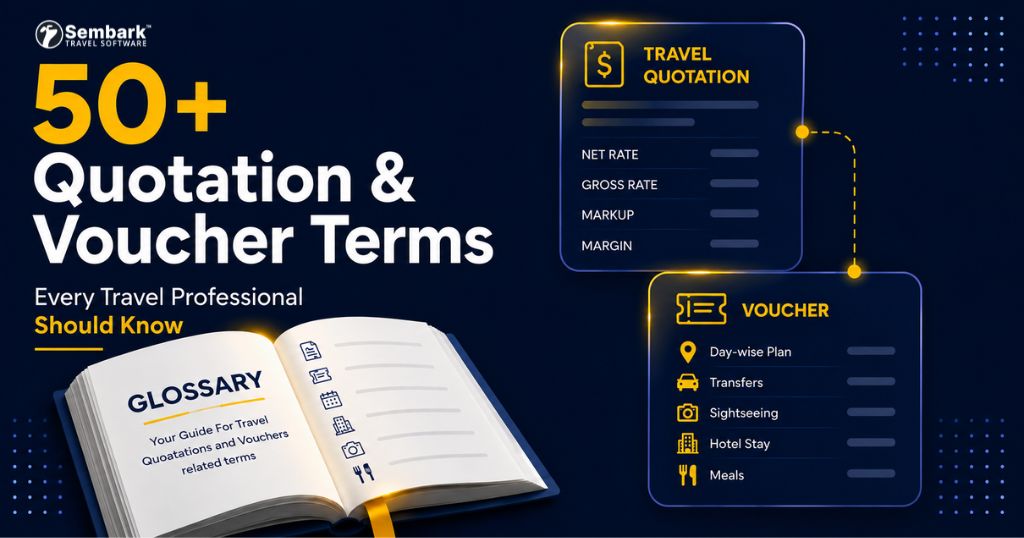
That’s exactly why we put this glossary together. 50+ Travel Quotation and Voucher related terms, explained simply and clearly, so your entire team knows exactly what they’re working with, every single time.
Travel Quotation Terminologies (25)
| Quotation Basics |
| Quotation |
| Tour Itinerary |
| Cost Sheet |
| Package Cost |
| Pricing Breakdown |
| Pricing & Revenue Terms |
| Net Rate |
| Gross Rate |
| Markup |
| Margin |
| Package Discount |
| Package Components |
| Inclusions |
| Exclusions |
| Add-On Services |
| Supplements |
| Optional Tour |
| Guest & Group Pricing |
| FIT (Free Independent Traveller) |
| GIT (Group Inclusive Tour) |
| Child Rate |
| Extra Adult Rate |
| Single Supplement |
Travel Voucher Terminologies (25)
| Booking & Confirmation Terms |
| Booking Reference Number |
| Voucher Number |
| Confirmation Number |
| Reservation ID |
| Service Confirmation |
| Travel Document Terms |
| E-Voucher |
| Travel Voucher |
| Confirmation Voucher |
| Redemption Voucher |
| Supplier Voucher |
| Guest Information Terms |
| Passenger Details |
| Rooming List |
| Guest Manifest |
| Pickup Details |
| Emergency Contact |
| Service Execution Terms |
| Check-In Voucher |
| Check-Out Confirmation |
| Service Redemption |
| Supplier Acknowledgement |
| Service Fulfilment Confirmation |
Quotation Basics
1. Quotation
A quotation is the first formal document shared in response to an enquiry by a travel business. It includes details like proposed trip cost, inclusions, exclusions, itinerary details, activities included, hotel types, validity period, & payment terms. It is used by the customers to understand overall pricing & offerings before confirming a booking with the travel business.
2. Tour Itinerary
A tour itinerary document includes a detailed schedule of a trip that outlines the travel plan day by day. Typically, this includes destinations, accommodation, transportation, sightseeing activities, meal arrangements, timings, & other planned services. This gives travellers a clear overview of their journey.
3. Cost Sheet
A cost sheet is a type of internal document utilised by travel businesses to calculate the actual cost of a package they offer. Learning the best method to price a travel itinerary maps these supplier rates, operational expenses, taxes, service charges, & some other costs before determining the final selling price.
4. Package Cost
In simple words, package cost can be termed as the selling cost of a package. A price at which the travel itinerary is offered to the customer. This cost combines all included offerings such as hotels, transfers, sightseeing, meals, permits, and applicable taxes into a single consolidated amount with the markup (profit) of travel businesses.
5. Pricing Breakdown
A pricing breakdown is a type of costing where an explanation is provided of how the package has been costed. Under this, each component, such as accommodation, transportation, activities, meals, and taxes, is individually marked. This helps customers understand what contributes to the final price they will pay.
Pricing & Revenue Terms
6. Net Rate
This term is used when a base cost is given by a supplier, can be hotel supplier, transport supplier, or activity supplier, to travel businesses. In simple words, it is the wholesale price a supplier gives for the service they provide. This is a confidential cost which should not be revealed to the final customer. It has to be used by travel businesses after adding markup.
7. Gross Rate
Once markup, service charges, or commissions are added to the Net Rate, it becomes the Gross Rate of a Package (Selling Price). This is the amount given to the customer in a quotation, including the profit of a travel business.
8. Markup
Markup is the percentage (%) or amount added on top of the supplier’s net rate to get the selling price of a package. Markup on a package covers operational costs, sales efforts, and the profit of the travel business involved while preparing the quotation.
9. Margin
Margin is the profit percentage earned from a sale after deducting the actual cost from the selling price. It measures profitability and helps travel businesses evaluate the financial performance of packages and services they sell.
10. Package Discount
A discount is a reduction applied to the original package price to attract customers, close sales, or support promotional campaigns. It can be offered as a fixed amount or percentage without necessarily changing the package inclusions.
Package Components
11. Inclusions
Inclusions are the services, amenities, experiences & benefits covered within the quoted package cost. These can include accommodation, transfers, sightseeing, meal plans, guide services, permits, etc, details clearly confirming what the client will receive for the quoted price.
12. Exclusions
Exclusions are the items & services not included in the package cost offered to the customer and must be paid by the client separately.
13. Add-On Services
Add-on services are types of optional products or experiences that travel businesses provide and can be purchased by the customer in addition to their main travel package. For example, this might include airport lounge access, travel insurance, private transfers, upgraded hotels, special meal plans, or additional sightseeing tours.
14. Supplements
In cases where some special services/conditions are added to the quote on additional charges increasing the cost of travel services are called Supplements. Some examples of supplements in a package are peak-season surcharges, festival dates, room type upgrades, special meal requests, etc, beyond the standard package offerings.
15. Optional Tour
It is a case where, during the trip, an extra sightseeing activity or excursion is offered separately to the client from the fixed itinerary. Travellers might choose whether to purchase it based on their interests, budget, & available time during their trip.
Guest & Group Pricing
16. FIT (Free Independent Traveller)
FIT is a term which refers to an individual traveller, couple, family, or small private party who is travelling independently or in a group. FIT (Free Independent Traveller) bookings are mostly personalised with custom itineraries, accommodation choices, & travel arrangements as per the client.
17. GIT (Group Inclusive Tour)
GIT is a term that refers to a group of travellers who are going to follow a common itinerary & travel together under a pre-arranged package offered by a travel business. These tours typically include shared transportation, accommodation, experiences & sightseeing.
18. Child Rate
When children are travelling with adults, they are eligible for a discounted fee which is termed as “Child Rate.” This rate is mostly less than the adult rate & might differ according to the age of the child, occupancy arrangements, or supplier policies.
19. Extra Adult Rate
In cases where an extra adult is included in an accommodation exceeding the fixed occupancy of the room, then the rate applied is called the extra adult rate. This usually includes an extra bed, mattress, or shared existing bedding (depending on hotel policy) with the proposed meal plan.
20. Single Supplement
A single supplement change is an extra cost applied when a traveller decides to occupy a room alone rather than sharing. This compensates for the higher accommodation cost associated with arrangements of single occupancy.
Commercial Terms
21. Validity Period
The validity period is a fixed timeframe till which a provided quotation, rate, or travel package remains available at the stated price & conditions. After this period, rates, availability, & terms might differ for client or supplier.
22. Payment Terms
Payment terms specify the pre-decided schedule, instalment, conditions, & methods for completing payments related to a travel booking. Proforma Invoice for travel businesses outline requirements such as advance deposits, balance payment due date, payment modes accepted, & conditions applied on delayed or missed payments.
23. Cancellation Policy
A cancellation policy in a quotation defines the terms & charges applicable if a traveller wants to cancel a booking. It typically specifies cancellation deadlines, penalties applicable, non-refundable components, & the percentage of the booking amount to be retained.
24. Refund Policy
A refund policy defines the conditions under which a client will be eligible to receive money back after a cancellation, modification, or service disruption. It includes refund eligibility, processing timelines, deductions, & any supplier-specific restrictions applied.
25. Tax Component
The tax component refers to the taxes and government levies included in or added to the package cost. Common examples include GST, tourism taxes, hotel taxes, and other statutory charges that contribute to the final payable amount.
Travel Voucher Terminologies (25)
Voucher Types
1. Service Voucher
A service voucher is a document issued to a customer; it is proof of services they have paid for. In simple words, it is a confirmation document. This contains details of the booked arrangements, supplier information, service dates, & instructions.
2. Hotel Voucher
A hotel voucher is a confirmation document used at the time of check-in to verify the accommodation arranged. This document includes hotel details, guest names, room category, meal plan, check-in & check-out dates, plus any special requests or inclusions for customers.
3. Transfer Voucher
A transfer voucher confirms transportation services between locations such as airports, hotels, or attractions. It includes pickup details, vehicle information, service timings, passenger names, and emergency contact information for smooth coordination.
4. Sightseeing Voucher
A sightseeing voucher is the proof of booking for a tour, attraction, or sightseeing activity included in the package. It contains activity details, reporting time, meeting point, inclusions, client information, & supplier contact details for verification.
5. Excursion Voucher
An excursion voucher is a type of document that confirms participation in a specific day trip, adventure activity, or guided excursion. Service details, pickup arrangements, inclusions, exclusions, timings, & instructions required for the traveller to join the activity are included in this.
Related blog: 200+ Essential Travel Industry Terminologies
Booking & Confirmation Terms
6. Booking Reference Number
A booking reference number is a unique identifier assigned to each reservation by a travel business, travel CRM, or booking system. It is used to track, manage, modify, & retrieve booking details throughout the customer journey.
7. Voucher Number
A unique code assigned to a specific travel voucher for identification & verification purposes is called a voucher number. Travel companies & suppliers use it to validate services, track usage, & maintain accurate booking records.
8. Confirmation Number
A confirmation number is a unique ID issued after a supplier confirms a booking. This serves as official proof of reservation. This is often required for service verification & customer support.
9. Reservation ID
A reservation ID is a system-generated identifier. It is used to manage & track a booking within a supplier’s or travel company‘s reservation platform. A reservation ID initiates accurate record-keeping & facilitates booking modifications or inquiries.
10. Service Confirmation
When a requested travel service is accepted & secured by the supplier, then a service confirmation works as an official acknowledgement to it. It confirms availability & assures that the booked service will be delivered.
Travel Document Terms
11. E-Voucher
An e-voucher is a digital version of a travel voucher issued electronically via email, mobile app, or booking portal. This contains booking details, voucher numbers, & service information that the client can use from their mobile.
12. Travel Voucher
A travel voucher is a confirmation document issued against prepaid travel services & authorises the traveller to receive them from suppliers/travel businesses. This usually covers accommodation, transportation, tours, activities, etc included in the booking.
13. Confirmation Voucher
Once the supplier confirms a booking, a document is issued named a confirmation voucher. This is a proof of reservation, and it includes important details like service details, booking references, traveller names, & validity dates.
14. Redemption Voucher
A redemption voucher document allows a traveller to claim a specific prepaid service, activity, or benefit. It is important to present this voucher to the supplier at the time of service delivery for verification.
15. Supplier Voucher
A supplier voucher is a service document that is shared with hotels, transport providers, guides, or other vendors; it is the proof of a confirmed booking. Details such as services to be delivered, traveller information, & agreed booking details are mentioned in this.
Guest Information Terms
16. Passenger Details
Passenger details in a voucher refer to all the personal information of travellers that are required for booking & service delivery. Typically, this includes names, ages, gender, contact information, passport details, & other identification data where applicable.
17. Rooming List
In a group booking, a rooming list document is used to assign travellers to specific rooms. This document includes guest names, room categories, occupancy details, & special requirements. It helps hotels to manage accommodation efficiently.
18. Guest Manifest
A guest manifest is a comprehensive list that contains passenger information, travel dates, service arrangements, & contact details for operational & emergency purposes of all travellers. This gives a real-time headcount & is important for operations, logistics, emergency tracking, & identification
19. Pickup Details
Pickup details in a voucher should specify the information required for transportation services, including pickup location, date, time, passenger names, vehicle details, & driver contact information.
20. Emergency Contact
An emergency contact is the POC contact information provided by a travel business for use during emergencies on live trips. It enables travellers to quickly communicate important information in case of accidents, delays, or any other situations.
Service Execution Terms
21. Check-In Voucher
A check-in voucher is a document that is presented upon arrival at a hotel, resort, or service provider for verifying a confirmed reservation.
22. Check-Out Confirmation
A check-out confirmation verifies that the traveller has successfully used the service & that the booking is concluded. In short, it is a record issued after the completion of a hotel stay or travel service.
23. Service Redemption
Service redemption is a process of claiming a prepaid travel service by using a relevant voucher, confirmation number, or booking reference to the supplier for verification & service delivery.
24. Supplier Acknowledgement
Supplier acknowledgement is a formal confirmation given by a vendor indicating receipt & acceptance against a booking request or service order. This confirms the supplier’s commitment to deliver agreed services.
25. Service Fulfilment Confirmation
After booked services have been finally delivered, a Service Fulfilment Confirmation is the final verification. This is used for operational tracking, quality assurance, supplier reconciliation, & customer service records.
Read more: B2B Travel Vocabulary: Essential Travel Industry Terms
Conclusion:
At the end of the day, when your team understands the language behind these documents, things just work better, operations run smoother, fewer errors, clearer communication with suppliers, and less confusion over who confirmed what.
Go through this glossary with your team, save it, and share it. The more everyone understands these terms, the stronger and easier the whole process becomes for you, your operations team, and most importantly, your clients.