
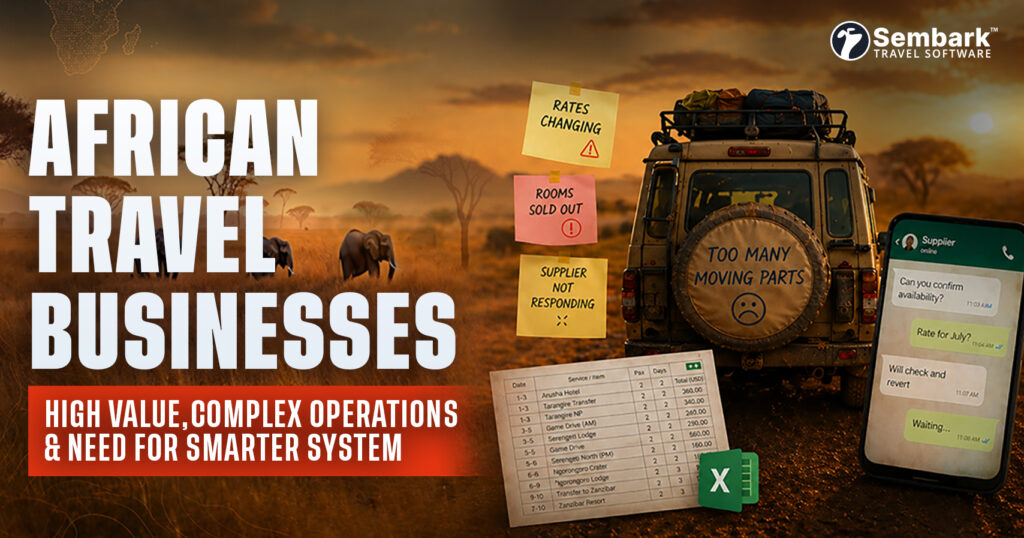
Imagine this: A group from New Delhi wishes to have a 10 days of Tanzania Itinerary, that is flexible and budget-friendly, of a circuit covering Tarangire, Serengeti, Ngorongoro Crater, & finishing with the beaches of Zanzibar. For a travel business in Tanzania, this means: coordinating through multiple lodge contracts, identifying appropriate accommodations, calculating per-person prices for activities depending on future seasonality, checking flight availability, & managing multiple suppliers for the same transfers.
Each segment of a travel itinerary depends on numerous suppliers, different availability windows & multiple pricing structures. What appears at first sight to be an individual travel itinerary is really a string of interdependent operations running through different fragmented systems.
Africa: Shift from Dream to Real Challenges
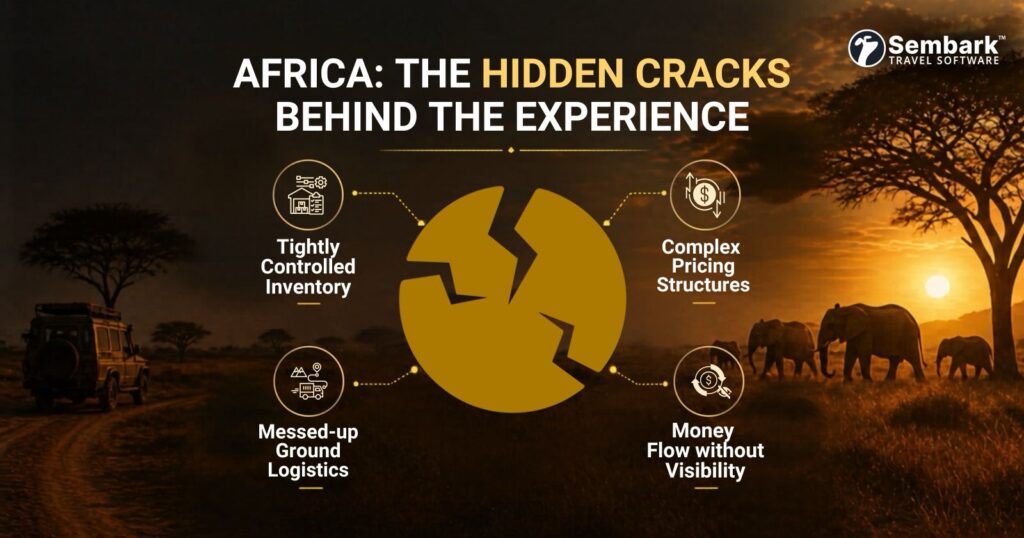
Inventory is tightly controlled:
- Lodges inside parks have limited rooms
- Early blocking is essential (sometimes 6–12 months ahead)
- Operators struggle with Overbooking risks, and Holding inventory without guaranteed clients
Complex Pricing Structures: One of the biggest challenges with quotations is the highly complicated safari and lodging pricing rules. Safari pricing in Africa is not standard; it is driven by a lot of variables.
- Seasonality – Peak wildlife seasons (like migration in Serengeti National Park and Masai Mara) can make prices 2–4x higher than low seasons.
- Scarcity & Location – Limited rooms inside parks, exclusive lodges, and remote fly-in properties cost more.
- Logistics – Distance, flights, vehicles, fuel, and guide costs directly impact pricing.
- Inclusions – Safaris are bundled (stay + meals + game drives + park fees), so prices vary widely based on what’s included.
- Wildlife value – You’re paying for the chance of sightings, not guaranteed experiences.
But the biggest driver: Operator Relationships & Structuring
This is where most price differences actually come from
- Contracted vs Ad-hoc Rates
- Operators with pre-negotiated contracts get lower, stable rates
- Others depend on last-minute availability → higher prices
Guest Structuring (Adult/Child & Rooms)
- Child pricing varies by age and sleeping arrangement
- Sharing vs extra bed vs separate room changes cost significantly
- Poor room allocation = higher total price
Vehicle & Guide Cost Distribution
- Safari vehicles are priced per vehicle
- More guests = lower cost per person
- Private vs shared safari = huge price difference
Volume & Supplier Relationships
- High-volume operators get: Better rates, Priority availability, Flexible terms
- New/small operators pay more for the same lodge
Inclusion Structuring
- What’s bundled differs: Game drives, Park fees, Transfers
- Same lodge, different package = different price
Payment Terms & Risk
- Full advance payments → better pricing
- Flexible bookings or credit → higher rates
Custom Deals & Value Adds
- Free nights, upgrades, honeymoon benefits
- Not visible in base price, but impacts the final quote
Ground logistics without a single source: Operations in destinations like Kruger National Park or Etosha National Park, Namibia, are operated differently and usually require multiple different guides, vehicles, and suppliers.
Money Flow without Visibility: Travel businesses in Africa generally have to deal with multiple payments on an everyday basis, be it hotels in Kenya, or transport & permits in South Africa, each in different currencies, and all managed through spreadsheets. This poses an ever-present threat of missed deadlines, reconciliation issues, and strained relationships with suppliers.
On the surface, it may seem like an operational issue- but it goes much deeper. Because of the fact that there is no proper system to support how the travel business in Africa actually operates.
Why can’t current Travel CRM Solutions in Africa solve all the problems?
Tourmatic: Known as Africa’s Favourite Safari Software, it covers a wide range of sensible backend operations, such as managing leads, sharing first quotation and collecting payments. But it entirely lacks setting complex contractual rates and post-confirmation booking management.
SafariOffice: This has been adopted widely in the African safari market and is effectively used as a sales and quoting tool, so although it can efficiently build itineraries, manage leads, and communicate with clients, however in terms of payment tracking and real-time management of suppliers, they fall outside its domain entirely, implying that all financial oversight happen outside the platform, manually. Also, the software comes up with a higher pricing compared to peers with fewer features.
Safari Portal: A system that is popular with travel businesses constructing premium itineraries, especially those operating in the African safari-centric markets. It quickly builds beautiful & visually interactive itineraries for authentic client-facing experiences, along with invoicing & financials available as add-ons. But when it comes to addressing deeper operational complexities like the real-time availability of hotels and activities, transport coordination across multiple regions, or handling fragmented multi-supplier networks, these are not a part of its feature set. In simple words, it is a powerful proposal tool that lacks operational depth.
Though some of the external issues might be resolved with some of these tools, none of them were designed specifically to take the full load of running a travel businesses in Africa, and it is this loophole where close-called bookings are lost entirely.
Related Blog: Proforma Invoice Template Free Download for Travel Businesses
What Travel CRM African Travel Businesses need
Challenges in making an itinerary for Africa
- Complexity in building accurate day-wise plans with multiple variables
- Multi-leg itineraries via hubs (JNB, NBO) become complex to plan
- Constant shifts in the schedule disrupt the entire plans of the trip.
Related blog: How Itinerary Builder Software Boosts Your Travel Company’s Success
How Sembark’s 60-Second Itinerary Builder solves it
- Dynamic PAX-wise pricing: Auto-adjust pricing based on group size with flexible options like per-person pricing, per-component per-person pricing.
- Day-wise planning: Create or update plans across the day without recreating the itinerary.
- Multi-leg trip handling: Seamlessly structure complex routes with clear segmentation
- One-click updates: Modifications reflect across the itinerary in real time without having to make any manual corrections.
Watch now: Create Beautiful & Professional Itineraries within Seconds
Challenges in Supplier Management
- Handling bulk bookings (groups) creates chaos in tracking the availability of rooms, transfers, and activities accurately
- A wide diversity of hotels, activities, and transport makes it difficult to maintain suppliers’ data.
- Supplier communication scattered across WhatsApp, calls, and emails causes errors in booking & reservations.
How Sembark’s Advance Supplier Management solves it
- Centralized supplier database: Data related to all hotels, transporters, and activity providers is stored in a single structured inventory.
- Bulk availability handling: Easily manage group requirements with 1-click access to availability & blackout dates
- Pre-loaded rates & contracts: Everything is ready while building bookings
- Consistent booking outputs: Standardised data ensures accurate reservations every time
Challenges in managing post-sales
- Multiple guides, vehicles, and suppliers increase coordination complexity
- Lack of standardisation in how trips are executed in different regions
- Heavy reliance on manual communication (calls, WhatsApp, emails)
- High chances of miscommunication between teams and suppliers
How Sembark Accelerates Post-Sales Operations
- Centralised Booking Dashboard: Track all hotels, transfers, and activities in one place. Get a clear visibility on who is assigned what (guides, vehicles, suppliers).
- Smart Movement chart: All booking displayed in one calendar in one system with real-time updates. This eliminates reliance on calls, WhatsApp, and scattered information.
- Automated Voucher Generation: Instant, error-free vouchers for all services so everyone (supplier, guide, client) works with the same information instantly.
Watch Now: Always on Track with Live Tour Movement Chart
Sembark: Best Travel CRM For Africa Travel Business
The travel business in Africa is not the easiest one, and your CRM cannot be simplistic & basic. From complex itineraries and supplier chaos to on-ground execution, you require a system that actually supports the way your business operates. SEMBARK brings everything together: sales, suppliers, operations, and control into one powerful platform. If you’re serious about scaling without breaking your processes, it’s time to upgrade.
Sembark: The Best Travel CRM for African Travel Businesses. Book your free demo today.