

You know, somewhere between a traveler’s flight touching down at the destination and their cab pulling away for the airport at the end of the trip, there’s an entire industry working quietly behind the scenes to make sure everything in between goes right. Here at Sembark, we spend our days building software for exactly that industry, so we figured we should take a proper look at it and put together this blog for you.
Let’s start with the stats that actually matter. According to Research Nester Report, the Destination Management Service Market size is expected to be $9.83 billion in 2026, and is expected to be on track to exceed $16.85 billion by 2035, expanding at over 6.1% CAGR between 2026–2035. A separate report by Market Research Future tells a pretty similar story: growth from $9.1 billion in 2025 to $16.7 billion by 2035, at a CAGR of 6.2%. Two reports, two slightly different numbers, but both pointing in the same direction.
So what exactly is this industry, one that’s worth billions and only getting bigger, and yet so many people have never even heard of it?
According to the Association of Destination Management Executives International (ADMEI), a destination management company is “a professional services company possessing extensive local knowledge, expertise and resources and specializing in the design and implementation of events, activities, tours, transportation and program logistics.”
In simple terms, that means Destination management services handle the local planning coordination, and delivery of travel and event services within a specific destination, things like event management, tours and activities, ground transportation, and program logistics . A DMC primarily delivers these services on behalf of tour operators, travel agencies, and corporate or event-planning clients.
This is exactly why this market matters to you, whether you’re a tour operator, travel agency, event organiser, or a DMC serving them. This growth isn’t some abstract number sitting in a report somewhere, you’ll feel the growth directly in your booking mix, as higher lead volume, and services that are worth investing in next.
Here’s a good example of what we mean: international tourist arrivals hit an estimated 1.52 billion in 2025, up 4% from the year before. And behind a large share of those arrivals is a booking, an itinerary, or an event that needs someone local to actually execute it on the ground, which is exactly where that growth turns into real lead volume and demand for you
Source: UN Tourism
Our team went through the primary research reports so you don’t have to dig through the full data yourself. We’ve pulled together everything we found on the statistics and trends shaping this market and compiled it all here, along with their sources linked throughout so you can check everything for yourself.
Table of Contents
Destination Management Service Market Size and Forecast, 2026–2035
This growth isn’t just one firm’s guess. Several research firms, looking at different years, all point the same way. Here’s what the numbers actually show:
| Year | Market Research Future | Research Nester | Fundamental Business Insights |
| 2025 | $9.1B | $9.32B | $9.42B |
| 2026 | — | $9.83B | $9.93B |
| 2035 | $16.7B | $16.85B | $17.03B |
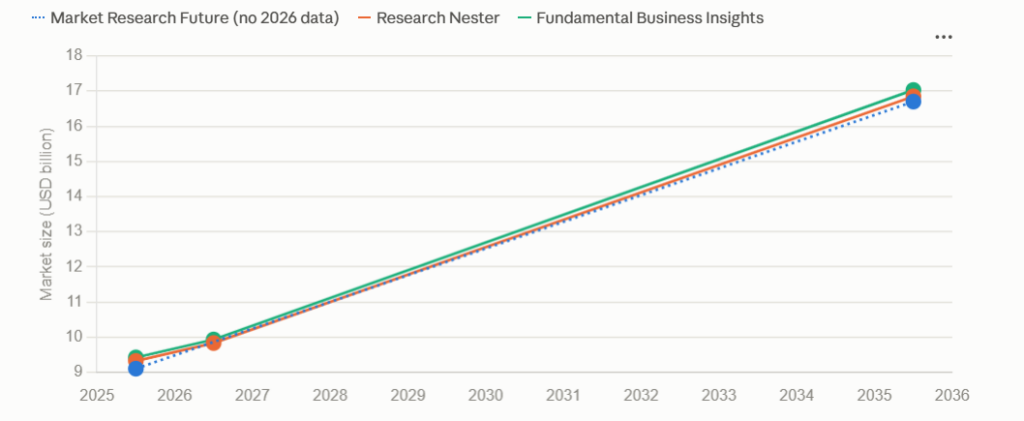
All 3 firms land on roughly the same CAGR, just over 6% for 2026-2035, so the market is expected to nearly double in size over the decade.
Destination Management Service Market Share by Service Type
The last section looked at how big this market overall. This one will be about where that money actually goes, which services make up most of a DMC’s business, and which ones are growing fastest.
A handful of service categories keep showing up across every report on this market: Event management, Accommodation booking, Transportation and logistics, Booking and reservations, Excursions and activities, Itinerary and activity planning, and Destination consulting.
Event Management
- According to Research Nester, event management will be the service type that accounts for more than 37.1% of the market by 2035.
- And it’s not just a future projection, either. According to Fundamental Business Insights, event management already held 41.2% share in 2025, making it the largest service type that year.
- A lot of this growth is being driven by MICE programs, corporate offsites, and destination weddings, all of which involve heavy coordination.
- This is where Sembark’s Lead Management and Smart Tour Calendar features earn their place, keeping every event lead organized and catching resource clashes, like the same driver or coordinator double-booked across two events on the same day, before they become a problem on the ground.
Source: Destination Management Service Market Size & Forecasts 2026-2035 By Segments
Booking & Reservations
- According to Market Research Future, booking and reservations is the current market leader by share, ahead of every other service type.
- Which makes sense, because even a fully customized trip still needs confirmed flights, hotels, and transport running smoothly behind the scenes.
Accommodation Booking
- MarketIntelo puts accommodation booking at 21.8% of 2025 revenue, making it the third-largest segment in its breakdown.
- And honestly, that makes sense, as booking accommodation is one piece almost every trip needs, whether a DMC is running a single hotel stay or stitching together a multi-city itinerary.
Source: Destination Management Company Market Research Report 2034
Excursions & Activities
- MarketIntelo puts this segment at 15.4% of 2025 revenue, covering guided tours, adventure activities, and other curated on-ground experiences.
- And it makes sense why this one’s picking up steam: travelers are done settling for the standard sightseeing checklist. They want something that feels authentic, something curated & personalised just for them, not a bus tour that stops at the same five spots as everyone else’s.
Itinerary & Activity Planning
- The actual size of this segment matters less than what it represents: this is where most DMCs try to stand out, since the underlying travel inventory often looks the same across operators.
- Which is what Sembark’s Smart Itinerary Builder is built for, letting DMCs put together a polished, accurately priced itinerary in about a minute, instead of building one manually in Excel or Word each time.
Transportation & Logistics
- According to MarketIntelo, transportation makes up 24.2% of 2025 revenue, with logistics management adding another 6.8% on top of that.
- Whereas most other reports name this as a core service category without attaching a specific number to it at all.
Destination Consulting
- No report provides a dedicated share figure to destination consulting on its own. Generally, this service type folds it into “Others” category instead.
- Which is fitting in a way, since it’s best understood as a value-add rather than a standalone revenue line, the one place a DMC gets paid for knowledge rather than just execution.
As you’ve probably noticed by now, no single service type owns this market outright. And that’s exactly why DMCs that can flex across event coordination, bookings, and itinerary planning tend to hold up better than ones betting on just one lane.
Destination Management Service Market Share by Travel Purpose
The last section looked at individual services. This one looks at why people are actually traveling, and how much money sits behind each reason.
MICE
- According to Grand View Research, MICE was worth $945.6 billion in 2025, projected to reach $1,028.9 billion in 2026, growing at 8.6% a year through 2033.
- Whereas other firms estimate anywhere from $836 billion to $1.3 trillion for the same year, so the exact number shifts depending on who you ask.
- Either way, DMCs only capture a slice of this pie. The actual piece is the local execution, actually running the venues, transport, and on-ground logistics, working alongside event organizers, convention centers, and hospitality groups to pull it off.
- Which is exactly where Sembark’s Lead Management and Smart Tour Calendar features come in, built for this kind of coordination-heavy work.
Source: MICE Market (2026 – 2033)
CORPORATE TRAVEL
- Corporate travel is one of the segments that dominate the Destination Management Company market, according to MarketIntelo, at $1.94 billion and 40.4% of 2025 revenue.
- More companies are outsourcing destination logistics to specialized DMCs to cut travel overhead.
- Which is also fueling the rise of “bleisure” trips, where business travel stretches into a bit of leisure time on either end.
ADVENTURE TOURISM
- According to Grand View Research, adventure tourism was worth $464.3 billion in 2025, projected to grow to $534.4 billion in 2026 and hit $1.76 trillion by 2033, at an 18.6% CAGR.
- Whereas other firms put the 2025 figure anywhere from roughly $460 billion to over $700 billion.
- Either way, the direction is consistent: adventure travel is one of the fastest-growing reasons people book a trip at all.
SPORTS TRAVEL
- According to Grand View Research, sports travel was worth $803.9 billion in 2025, projected to hit $927.9 billion in 2026 and $2,776.7 billion by 2033, a 16.8% CAGR.
- Interestingly, passive sports tourism, people traveling to watch an event rather than compete in one, led the market with a 42.8% share in 2025.
- Which shows just how much of this growth is coming from spectators, not just athletes.
LEISURE TRAVEL
- According to Fundamental Business Insights, leisure travel captured 48% of the destination management service market in 2025, the largest share of any application segment that year.
- Which lines up with a separate finding from Research Nester: individual travelers, specifically, are projected to account for more than 49.3% of the market by customer type by 2035.
- We dig deeper into exactly who these travelers are in the next section.
Between MICE, adventure travel, and sports tourism, the money moving around this market’s edges is often bigger than the DMC industry itself, and it’s still growing faster than the core market. Leisure travel, meanwhile, remains the quiet constant underneath it all, the largest single reason people book with a DMC in the first place.
Destination Management Service Market Share by Customer Type
Numbers on their own don’t mean much without knowing who’s actually generating them, so this section breaks the market down by customer type: the four groups a DMC typically works with, and how much of the pie each one holds.
Individual Travellers
Individual travelers are expected to hold more than 49.3% of the market by 2035, according to Research Nester. This group is exactly who it sounds like: solo travelers, couples, and families booking personalized itineraries and hotel stays directly, rather than going through an agency or an employer.
Tour Operators
Tour operators make up the second-largest end-user segment, at 32.1% market share, according to MarketIntelo. They lean on DMCs for on-the-ground coordination, activity planning, and local execution, so they can package complete tours without building out their own ground operations in every destination.
Travel Agencies
Travel agencies are actually the largest end-user segment in MarketIntelo’s breakdown, representing $1.73 billion and 36.0% of market revenue in 2025. For the most part, they play the middleman, packaging DMC-delivered ground services into their own client offerings instead of sourcing every piece separately.
Corporate Buyers & Event Planners
Event organizers are what Market Research Future calls a “dominant force” in terms of raw demand. It’s easy to see why. A single event program can mean coordinating venues, accommodation, and transportation for hundreds of attendees all at once, which is exactly why this group punches so far above its actual numbers.
Regional Destination Management Service Market Share
Every market looks different depending on where you stand geographically. This section breaks the pie down by region, and shows why each one sits where it does.
North America
- North America holds the largest share of the market today, at around 45%, according to Market Research Future.
- And it makes sense why: this region got there first, with decades of infrastructure investment, a mature travel industry, and steadily rising corporate travel giving it a head start over everyone else.
- We can expect that lead to narrow a bit though, with Research Nester projecting North America down to 35% by 2035, simply because other regions are growing faster off a smaller base.
Europe
- Europe sits second by market share, but first by raw tourist volume, welcoming 793 million international tourists in 2025, up 4% from the year before (UN Tourism).
- So why doesn’t it top the list despite all those visitors? A lot of that travel gets handled through Europe’s own dense network of local agencies, rather than centralized DMCs the way it happens in North America.
- We don’t see that gap closing anytime soon either, since Europe’s agency-heavy setup isn’t likely to shift toward DMCs the way other regions have.
Asia Pacific
- Asia Pacific holds around 20% of the market today, putting it third, according to Market Research Future.
- It’s sitting here for a simple reason: demand is still catching up to infrastructure, even as China, Japan, India, and Australia keep pushing that demand higher.
- This is the one region we’d watch closest going forward, since rising incomes and growing business travel are expected to close that infrastructure gap faster than anywhere else.
Middle East and Africa
- The Middle East and Africa remain the smallest region today, at around 5% of the market, according to Market Research Future.
- It’s at the bottom mostly because its tourism infrastructure and DMC networks are still newer than everywhere else.
- But that’s exactly why we think it’s worth keeping an eye on: tourism initiatives and hospitality investment in places like the UAE and South Africa are already giving this region real momentum, even from a small starting point.
| Region | Approx. current share (MRFR) | Growth outlook |
| North America | 45% | Steady, led by corporate and experiential travel |
| Europe | 30% (inferred) | Growing, led by international events and tourism recovery |
| Asia Pacific | 20% | Fastest growing, led by rising incomes and business travel |
| Middle East and Africa | 5% | Early stage, led by tourism initiatives and hospitality investment |
No matter which region you operate in, the pattern is the same: infrastructure and demand are racing to catch up with each other, and the DMCs that close that gap first are the ones who end up winning the region.
Destination Management Service Trends Through 2035
A handful of trends kept showing up across every recent report we looked at, and they’re worth knowing whether you run a DMC or just work alongside one.
Personalization
- Nearly half the market, 49% in 2025, is made up of travelers who want their trip planned around them specifically, not pulled off a shelf, according to Fundamental Business Insights.
- So personalization has quietly stopped being a perk you offer and become the thing most of this market is already built on.
Technology Adoption
- DMCs are leaning on AI now to build itineraries that actually adapt to how a traveler behaves and what they’ve booked before, rather than sticking to a fixed template, according to MarketIntelo’s 2025 analysis.
- And once travelers get used to that kind of responsiveness, going back to a static itinerary in a spreadsheet starts to feel like a step backward.
Sustainability
- Travelers are putting real weight behind this one. 85% say traveling more sustainably matters to them, either “important” or “very important,” according to Booking.com’s Travel & Sustainability Report 2026.
- Which means “eco-friendly” isn’t just a line that people say anymore, it’s become something people actively filter for before they book.
Emerging Markets
- Africa outgrew every other region in the world in 2025, up 8%, with North Africa leading the charge at +11% (UN Tourism).
- Southeast Asia and South America are picking up similar momentum, which is exactly the kind of window a DMC wants to walk through early, before the competition catches on.
Every trend here points in the same direction: the DMCs winning through 2035 won’t be the biggest ones, they’ll be the ones who stayed personal, stayed current on tech, and got to the next market before it was obvious.
Conclusion
Put simply, the destination management service market is on track to grow from around $9.1–9.4 billion today to somewhere between $16.7 and $17 billion by 2035, at roughly 6.1–6.2% a year. Personalization, AI-driven planning, and sustainability are becoming the baseline travelers expect, not extras that set a DMC apart. Meanwhile, emerging markets like Southeast Asia, Africa, and South America are opening up fresh ground for DMCs willing to build a presence there early, before the competition catches up.
As the market grows, DMCs and tour operators are going to need tighter control over leads, quotations, suppliers, reservations, payments, and day-to-day operations, or all that extra demand ends up costing more in manual work than it earns in revenue.
That’s what Sembark is built for. It’s a travel CRM that helps DMCs, tour operators, and travel agencies manage leads, itineraries, suppliers, bookings, and payments in one place, instead of chasing all of it across spreadsheets and WhatsApp chats.
If you want to get ahead of where this market is headed, book a Sembark demo and see how it fits into how you already work.

Q. What is the difference between a DMC and a DMO?
A. A DMC, or Destination Management Company, is a professional services company with extensive local knowledge, expertise, and resources, specializing in the design and implementation of events, activities, tours, transportation, and program logistics. A DMO, or Destination Management Organization, on the other hand works differently: it’s usually a public or semi-public body, like a tourism board, focused on promoting and developing a destination for the long term, rather than executing individual bookings or events for specific clients.
Q. What are the biggest challenges facing destination management companies through 2035?
A. Two challenges stand out. The first is unpredictability outside anyone’s control, natural disasters, political unrest, visa restrictions, and general bureaucratic friction can all disrupt travel demand overnight, leaving DMCs with little time to adjust. The second is intense competition and pricing pressure, where smaller DMCs often find themselves squeezed by larger, better-resourced players who can absorb thinner margins and still win the business.
Q. What factors are driving destination management service market growth?
A. Several forces are pushing this market forward. Rising demand for personalized travel experiences tops the list, as more travelers expect trips built around them rather than off a shelf. Alongside that, DMCs are expanding into emerging markets, building deeper partnerships with local tourism stakeholders, and adopting AI-driven planning tools faster than ever before, all of which are helping the industry grow at a steady pace.