
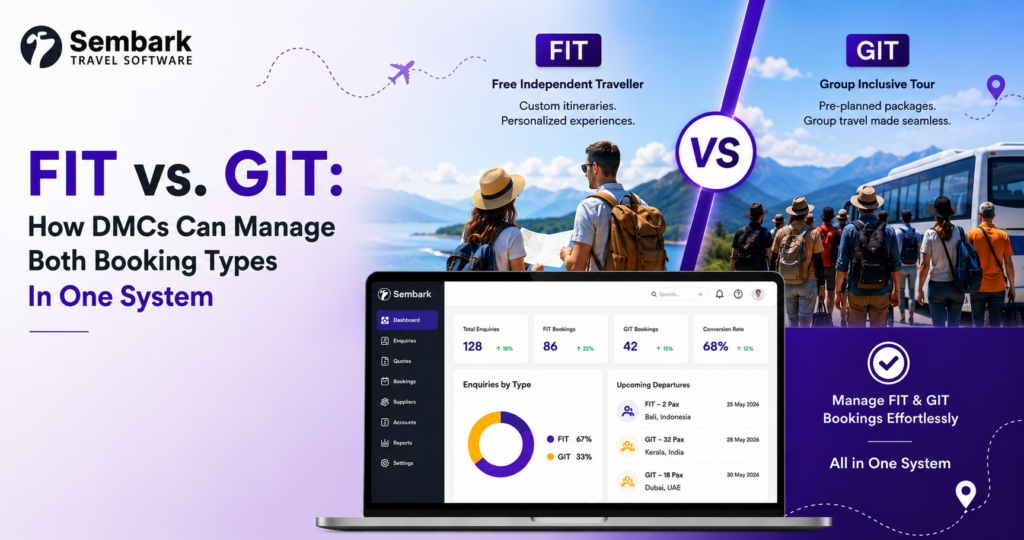
If you’re a DMC, you know the daily juggling act all too well. Imagine getting multiple emails, one email from a couple wanting last-minute changes to their honeymoon itinerary, and the next one about a corporate group of 40 members who are landing in 9 days, and need rooms, buses, and a conference hall that needs to be confirmed yesterday.
Both are your clients. Both bookings need your full attention. But the processes of both are completely different.
FIT and GIT bookings don’t just look different on paper; they pull your team in different directions, with different supplier conversations and paperwork at different speeds. Most DMCs that manually run their operations end up managing everything on spreadsheets, WhatsApp threads, and a few overworked employees holding everything together.
When they are not able to manage these different bookings well, that’s exactly where details start slipping: missed follow-ups, delayed confirmations, and errors that become visible on the day of travel.
At Sembark, we work closely with DMCs handling both booking types every day, and that’s exactly why we created this blog: to break down the FIT vs GIT difference, show what each one actually means in day-to-day DMC operations, and explain how a well-built DMC operations software like Sembark Travel Management Software helps you handle both without the chaos.
Let’s start from the beginning, because the labels themselves carry real operational weight.
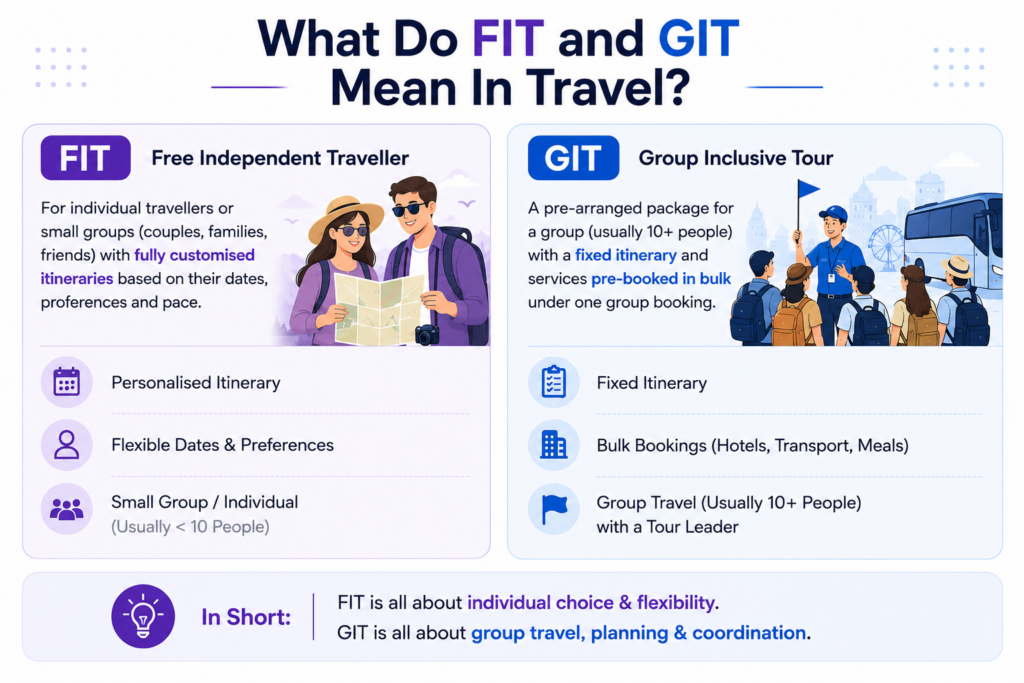
What do FIT and GIT mean in Travel?
FIT (Free Independent Traveller) refers to a single traveller or a small group of travellers, often a couple, a family, or friends travelling together, for whom the DMC builds a fully customised itinerary which is tailored according to the specific dates, preferences, and pace, as opposed to a fixed group itinerary shared by all travellers under one booking.
GIT (Group Inclusive Tour) means a pre-arranged package for a group travelling together with a fixed itinerary, and with accommodations, transport, and meals, all pre-booked in bulk under a single group booking. In the DMC context, the group usually consists of people with common connections, such as a corporate team, school batch, or pilgrimage group, and is typically accompanied by a tour leader who coordinates the group throughout the trip.
If we look at the most basic FIT vs GIT difference:
- GIT bookings usually require a minimum of 10 travellers, though this may vary based on suppliers and contracts. FIT bookings, on the other hand, are a private party of fewer than 10, with no minimum/maximum headcount requirement.
- A GIT itinerary is fixed and applies to the entire group, so even something as routine as a hotel swap means changes with respect to all booked rooms, vehicles, and meals that were already blocked for that group. With FIT, the same change affects only one traveller’s plan and nothing else.
- FIT requests typically arrive through a travel agent representing an individual traveller or small group, or travellers make bookings directly through website enquiries and referrals. Whereas GIT requirements usually come from travel agents, corporate accounts, or group organisers, often with a pax count that is still not confirmed.
But Why Does This Distinction Matter For DMCs?
FIT or GIT is not just a label that you put on a booking; it changes the entire process & how your team works on it, from the first enquiry to the final voucher.
An FIT booking demands speed and flexibility above everything else. The travellers compare quotes in real time to find a perfect quote with the perfect price and want the freedom to make changes and tweak the itinerary without it becoming a logistical problem.
A GIT booking is the opposite. It demands coordination and bulk management. Here, you’re not pricing just one room; you’re managing multiple rooms, an entire fleet of vehicles, and meals for an entire group under one arrangement, where nothing sits in isolation.
And that difference runs through every part of how you handle each type of booking:
- The quoting process looks different from the start. One is built around a single group of travellers’ request, while the other is priced per person and is headcount-dependent.
- Supplier negotiations are also completely different, as FIT and GIT bookings involve different rates, different contracts, and different FOC-related conversations.
- Voucher Generation is a different job entirely. Where FIT booking produces one trip voucher and one hotel voucher per booking, containing guest-specific details. On the other hand, a GIT booking means generating trip and hotel vouchers across bulk-booked hotels and services for an entire group.
- Payment tracking follows a different rhythm, too. When it comes to GIT, who pays, how they pay, and how many times they pay before the account is settled looks nothing like it does on the FIT side.
This is the reality of running a DMC, and this is what your team is navigating every single day. Now let’s look at each of these differences in detail.
FIT vs GIT: Key Operational Differences DMCs Deal With Every Day
Group Size and Itinerary Structure: FIT usually means under 10 travellers, with the itinerary built entirely around them. GIT is a group tour, usually starting with 10 or more travellers, all following one fixed itinerary with no per-traveller changes.
Enquiry Source and Assignment: The individual travel booking workflow for a FIT is simple and straightforward: when an enquiry comes, one sales executive picks it up and manages it from the first response to the final confirmation. A GIT requirement is different. Enquiries can come from multiple sources, and often, with a pax count, it needs more than one person, so sales, reservations, and operations all get involved from an early stage.
Flexibility and Change Management: When it comes to FIT bookings, a change like swapping a hotel or adding a night only affects that one traveller, couple, or small group. But with GIT, even a single change can affect the whole group, like a hotel swap means rechecking rooms for the whole block, and a headcount drop can change both the per-person price and FOC entitlement at once.
Quoting and Pricing: An FIT quote is generally fixed and finalised once the components are selected. Whereas a GIT quote is per-person and headcount-dependent, and since group rates and FOC allowances are typically tied to pax count, the price becomes final once the group size is locked in.
Supplier Rates and Negotiation: This is where supplier contract management looks completely different for the two booking types. For FIT, suppliers mostly work on net or individually negotiated rates, with each component priced separately. But in the case of GIT, the conversation is entirely different: you’re negotiating group rates, securing group discounts, and agreeing on FOC entitlements, all tied to a minimum headcount commitment.
Documentation: FIT produces a clean & simple set of documents, such as an individual voucher and a proforma invoice for travel businesses. Whereas, a GIT booking requires an entirely different set: a tour confirmation voucher covering all services, a rooming list with guest names and room allocations, and a proforma invoice sent to the travel agent outlining the full cost before final payment. Every document must be accurate before departure, because an error in any one of them affects the entire group.
Payment: FIT payment is straightforward: one booking, one account, a deposit followed by a final payment. With GIT, the travel agent or group organiser settles the full account in structured instalments tied to supplier deadlines, rather than managing individual payments from every traveller in the group.
Team Effort and Operational Risk: A FIT file is carried by one sales executive end-to-end, and the main challenge is getting every customised detail right for that one traveller or group. But a GIT booking is a different undertaking. It needs sales, reservations, operations, and suppliers all working within one file, and one gap in communication or confirmation affects the entire group, not just a single traveller.
Here’s the full comparison :
| Operational Area | FIT | GIT |
| Group Size | Solo traveller, couple, family, or small private group (usually under 10) | Commonly, 10 or more travellers under one booking |
| Itinerary | Fully customised to the traveller’s dates, preferences, and pace | Fixed itinerary, pre-designed and applied uniformly to the whole group |
| Flexibility | High (changes affect only that traveller’s plan) | Low (any change affects every room, vehicle, and meal already blocked) |
| Quoting | Built around one traveller’s exact request, fixed once components are selected | Per-person pricing; final price only confirmed once group size is locked in |
| Supplier rates | Net or individually negotiated rates, each component priced separately | Group rates, group discounts, and FOC entitlements tied to minimum headcount |
| Documentation | Single invoice or individual voucher | Tour confirmation voucher, rooming list, and proforma invoice must all be accurate before departure |
| Payment | One account, one booking, deposit, then final payment | The travel agent or group organiser settles the full account in structured instalments |
| Change Management | Affects one traveller’s plan only | A hotel swap, headcount drop, or date shift cascades across the entire booking |
| Operational Risk | Getting every customised detail right for one traveller or a small group | One gap in supplier communication or confirmation affects the entire group |
| Team Effort | Usually handled by one sales executive end-to-end | Requires coordinating sales, reservations, operations, and suppliers within a single booking file |
How Sembark Helps DMCs Manage FIT and GIT in One Place
Two booking types. Completely different operations. One system built to handle both without the chaos. That’s Sembark, a complete Travel CRM for DMCs, tour operators, and travel agencies that manages your leads, itineraries, vouchers, payments, and tour calendar in one place, so your team never has to think twice about whether a booking is FIT or GIT. The system handles both effortlessly.
If you’re looking for a DMC booking system that manages FIT and GIT bookings under one roof, here’s exactly how Sembark does it.
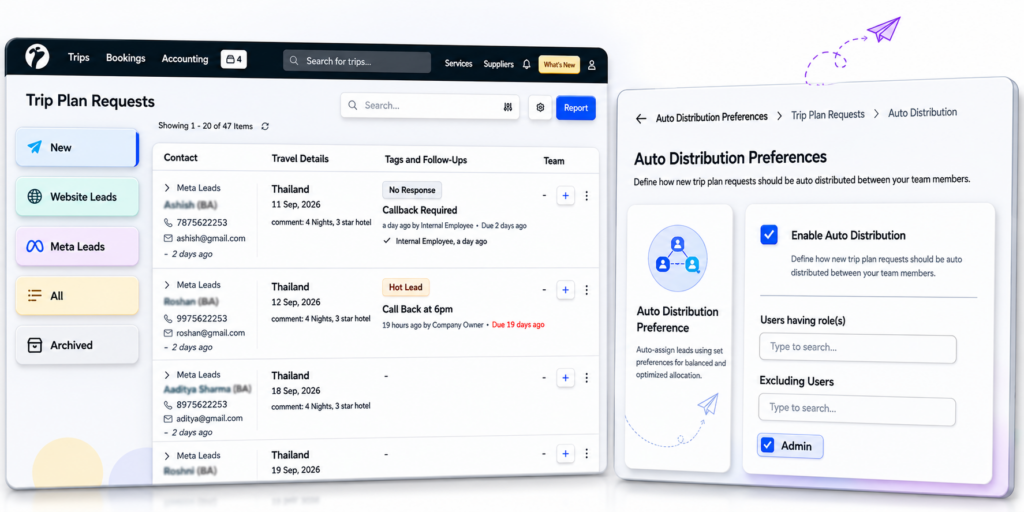
With Sembark’s Lead Management feature, you can auto-capture leads from multiple channels such as Google Forms, landing pages, websites, Meta ads, and more, and auto-distribute them to the right team member with zero manual effort. So every lead you receive, whether a customised honeymoon enquiry or a 40-person corporate group requirement, lands in one centralised dashboard and is instantly assigned to the right person.
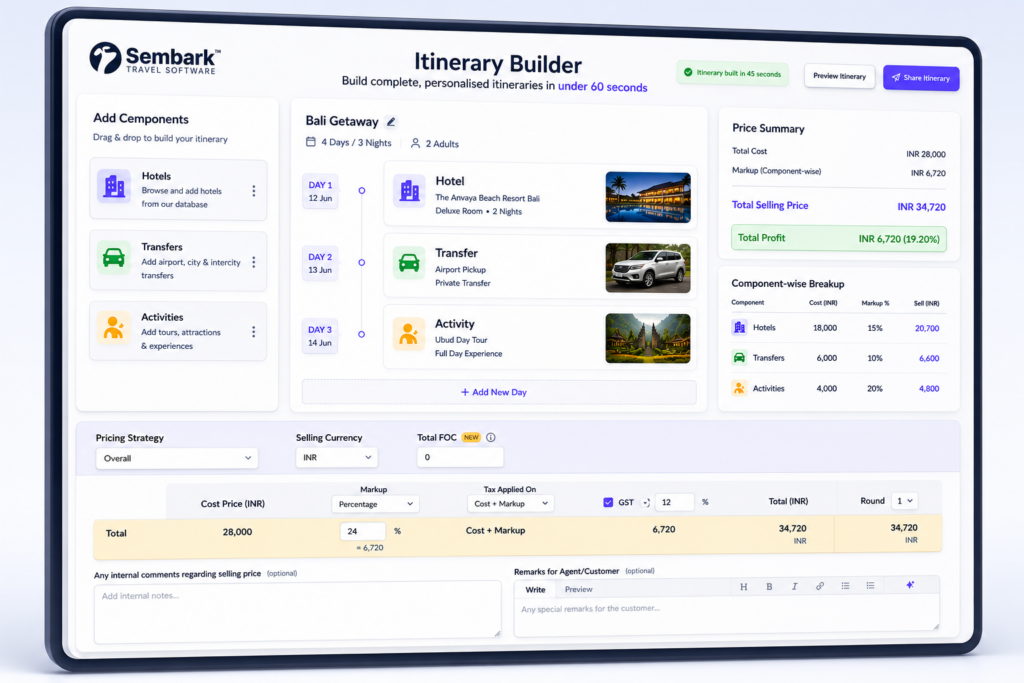
FIT booking management starts with speed, and Sembark’s smart itinerary builder gives you exactly that, building a complete, personalised itinerary in under 60 seconds by auto-fetching hotels, cabs, activities, and flights from a database, with component-wise markup and automatic cost and profit computation. Read our guide on how to price a travel itinerary to structure these markups perfectly. For GIT, where group itinerary management means tracking a price that shifts with every headcount update, Sembark offers 4 different pricing strategies, automatically computes costs, markups, and profits at every stage, and logs every amendment so every version you send to the agent is tracked, so there is no need to redo the entire quotation from scratch.
Payment & Collection Tracking:
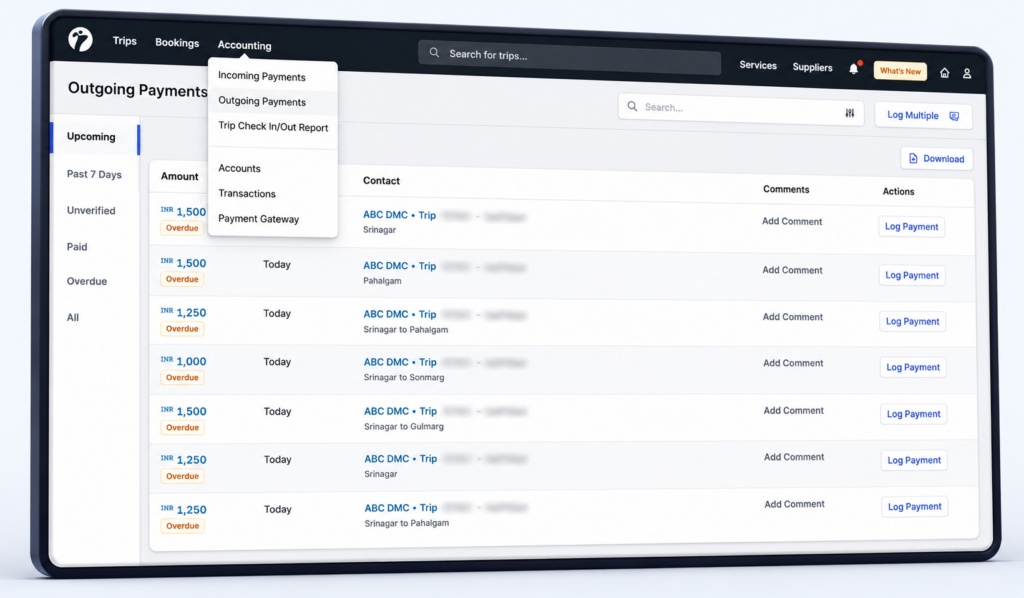
With Sembark’s payment and collection tracking feature, you can handle the full payment cycle for both booking types under one dashboard: track all incoming and outgoing payments in real-time that are automatically updated in the system. You can also monitor hotels, flights, and operational payments separately with due dates and 3-stage auto-reminders on phone, email, and software to ensure no due payment is ever missed.
Instant Voucher & Proforma Invoice:
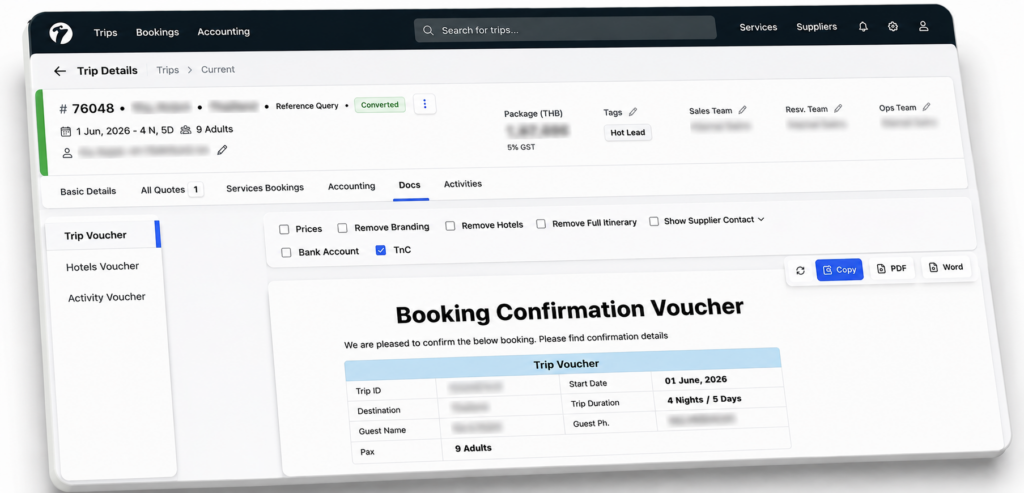
With Sembark, you can instantly generate error-free trip & hotel vouchers plus proforma invoices on booking confirmation for both FIT and GIT, with all details automatically fetched from confirmed trip data. No manual drafting, no wrong detail slipping through, and no last-minute corrections after the documents have already been shared with clients or suppliers.
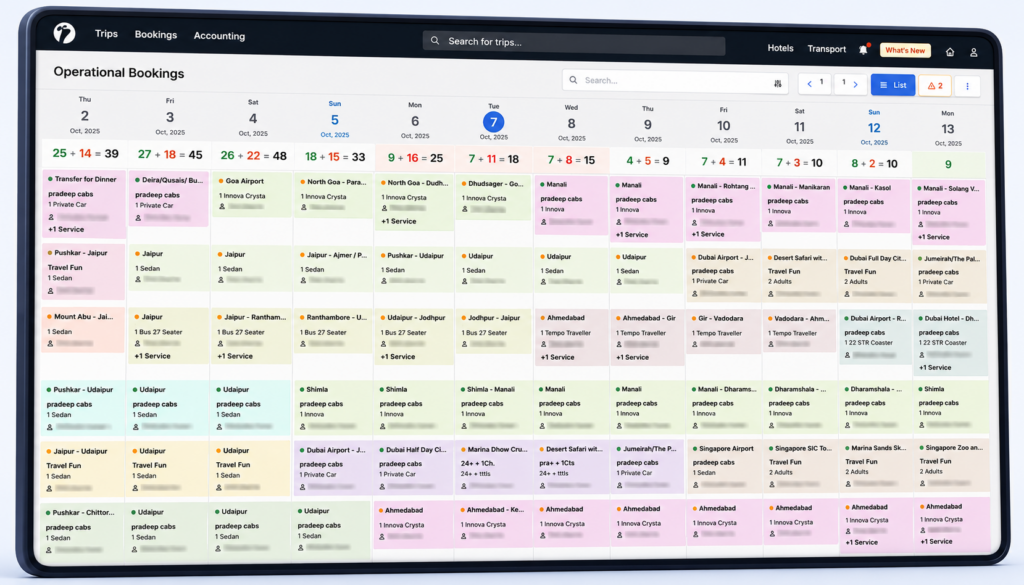
The biggest operational risk in GIT group travel operations is a coordination gap between sales, reservations, operations, and suppliers. Sembark’s Smart Tour Calendar eliminates that risk with a centralised, real-time view of all ongoing and upcoming FIT and GIT tours. Here you can see the schedules, driver details, booking status, and payment status on one screen, all automatically synced with confirmed trip data. So everyone from sales to operations always knows what’s happening, what’s next, and who’s responsible.
With FIT and GIT running in one system, your team stops juggling two separate workflows, and every employee finally works from one place instead of fighting two separate battles every day. One system, two booking types, zero chaos – that’s what Sembark is built for.
See how Sembark handles both booking types, from the first enquiry to the final voucher.

- Can a DMC manage FIT and GIT bookings in the same software?
A. Yes, and that is exactly what Sembark is built for. Leads from both booking types are auto-captured from Meta Ads, Google Ads, chatbots, landing pages, and more, and auto-distributed to the right team member with zero manual effort. From there, the same platform handles itineraries, supplier contracts, payments, vouchers, and the live tour calendar for every booking, whether it is a personalised FIT itinerary or a fixed GIT group package, so your team works from one place instead of jumping between tools.
- What documents does a DMC need for GIT bookings?
A. A GIT booking requires a more complete document set than an FIT booking: a tour confirmation voucher covering all booked services, a rooming list with guest names and room allocations, and a proforma invoice for the travel agent outlining the full cost before final payment. Every one of these has to be accurate before departure because an error in any single document affects the entire group, not just one traveller.
- What is an FOC in GIT, and how is it calculated?
A. FOC stands for Free of Charge. In GIT, it means the supplier gives one complimentary seat or room to the group organiser or tour leader after the group reaches a minimum pax count. A common example is 1 free pax for every 10 to 25 paying pax. The more pax you bring, the better the FOC you get. This is why a headcount drop in a GIT booking is a bigger problem than it looks, as it does not just change the per-person price; it can also reduce or eliminate the FOC the DMC had already counted on.
- Can Sembark manage supplier contracts for both FIT and GIT rates?
A. Yes. Sembark centralises hotel, transport, and activity contracts in one place with rate rules and validity dates, and automatically applies the correct rate when your team creates a quotation. For a DMC running FIT net rates and GIT group rates side by side, this means the right rate is applied to the right booking type, without anyone manually checking which contract applies before every quote.
- How does Sembark handle the coordination risk in a GIT booking file?
A. GIT requires sales, reservations, operations, and suppliers all working off the same file, and one gap in communication doesn’t stay contained; it affects the whole group. Sembark’s Smart Tour Calendar eliminates that risk with a single, real-time view of all ongoing tours, automatically synced with confirmed trip data, so your entire team, from sales to operations, always knows what’s happening, what’s next, and who’s responsible, before a gap ever opens.
Recommended Blogs: