
“We have run this business for years, and it works. Now every software vendor wants us to hand our quotes, enquiries and supplier packages to a system run by AI. What if something goes wrong?”
If you own a tour business, this is probably what you are thinking. Your quotes go out from Excel. Your team knows the rates, and WhatsApp keeps enquiries moving. You built the business this way. So why risk it on software that makes decisions you cannot see?
The doubt is fair, and many in the trade share it. In the 2025 Travel Weekly and Phocuswright survey of nearly 1,600 travel advisors, 63% had reservations about AI’s accuracy and its lack of a personal touch.
But the old way carries risks too. They are just quieter. Enquiries pile up on busy days. Rates sit in more than one sheet. When a senior person goes on leave, everyone else hunts for answers.
So the real choice is not between trusting AI and staying safe. It is about where the risk sits: in memory and copy-paste, or in a system with checks built in. The principle that keeps software safe is simple: AI does the reading and drafting, and your people decide what the customer sees.
AI adoption in travel is not the same as AI autonomy.
A travel consultant may happily use AI to draft an itinerary but may not trust it to confirm a hotel or modify a booking.
The real opportunity is not to replace travel professionals with AI. It is to remove the repetitive work that stops them from doing more valuable work: understanding customers, negotiating with suppliers, designing better trips and closing bookings.
This blog shows what AI actually does inside tour operator software, what checks are built in, how to set them up, and what still needs a human.
What AI Can Actually Change in a Travel Business
| Business function | Traditional approach | AI-assisted approach |
| Enquiry management | Manually read emails and WhatsApp | Extract requirements and organise leads |
| Itinerary creation | Build every itinerary from scratch | Generate drafts from business knowledge |
| Supplier quotations | Manually read PDFs and re-enter details | Extract hotels, services and inclusions |
| Sales follow-ups | Manually track pending quotations | Identify delayed follow-ups and draft reminders |
| Operations | Manually check multiple records | Summarise bookings and flag pending actions |
| Management reporting | Prepare Excel reports | Ask questions about business performance |
What AI Actually Does Inside the Software
Many people use “Automation” and “AI” as if they mean the same thing. Vendors do it too, and the confusion makes software hard to judge. They are two different things, and knowing the difference helps you see what you are actually buying.
Automation means machines doing a task that people once did by hand. Britannica defines it as the application of machines to tasks once performed by human beings, and it generally implies machines working as part of a self-governing system. In plain words, you set the rule once, and the system follows it every time.
AI is a machine-based system that takes in input and works out its own output. The OECD describes it as a system that infers, from the input it receives, how to generate outputs such as predictions, content, recommendations or decisions. In plain words, you give it something to read, like an enquiry email, and it produces something useful, like a lead or a draft itinerary.
| Task | Automation | AI |
| Lead assignment | Assign all leads from India to Salesperson A | Read enquiry and identify destination, trip type and requirements before suggesting assignment |
| Email management | Move emails with “booking confirmation” in the subject to a folder | Understand whether an email contains a new enquiry, revised quotation or supplier confirmation |
| Follow-up | Send reminder after 24 hours | Identify which quotation needs follow-up based on customer interaction |
| Itinerary | Add a predefined itinerary template | Draft an itinerary based on destination, budget and past trips |
| Supplier quotation | Copy data from a fixed template | Extract information from PDFs, Word files and unstructured messages |
How this looks in tour operator software
AI and automation work best together. AI understands unstructured information. Automation executes predefined actions.
For example:
- AI reads a supplier email.
- Extracts the hotel, dates and rates.
- Matches them against existing supplier records.
- Flags missing information.
- Automation updates the relevant record after approval.
- The employee reviews the result.
The Work Before Every Quote: Enquiries and Supplier Packages
Before a trip starts, a lot of time-consuming work has to be done. Enquiries need to be sorted and answered. Itineraries need to be built. Rates and quotations have to be copied from one file into another often manually.
Most of this work begins with reading. Most B2B enquiries still come through emails, and the inbox where they land is full of everything else: invoices, supplier emails, payment confirmations and follow-ups, and Somewhere in between, a genuine enquiry gets lost.
Then there are partner supplier quotations. When you sell a trip built by a partner DMC, their quotation arrives as a PDF, a Word file or a WhatsApp message. Someone has to read through every hotel, transfer and sightseeing line, and then rebuild it as your own quotation.
This is exactly where AI earns its place, because the input differs from one sender to the next and the work repeats. A good tour operator software with AI should do 3 things:
- Tell a real enquiry from everything else in the inbox
- Pick out what you need to quote: dates, travellers, destinations and hotel preferences
- Match what it finds to your own records instead of creating duplicates.
Where Travel Businesses Lose Time and Money Before a Booking Is Confirmed
1. Enquiry leakage
A travel agency receives enquiries through email, WhatsApp, website forms, phone calls and social media.
There is no single view of which enquiries have been responded to.
The problem isn’t just missed leads. It is the inability to measure how many enquiries are actually converted.
2. Rebuilding supplier quotations
A DMC receives supplier quotations from hotels, transporters and activity providers.
A Tour operator receives packages from partner DMCs.
The team manually reads the documents, transfers details and prepares a customer-facing quotation.
This creates duplication of work and introduces errors.
3. Dependency on experienced employees
A senior salesperson may know which hotels work best, which supplier is reliable and which routing is practical.
But this knowledge often remains in emails, spreadsheets and individual memory.
When that employee leaves, the business loses part of its operational knowledge.
4. Slow quotation turnaround
When customers approach multiple travel companies, the speed and quality of the response matter.
A delayed quotation gives the competitor an opportunity to close the booking first.
For example:
A team of five salespeople, each preparing six quotations per day, spends 30 minutes on each quotation.
That’s 15 hours of quotation preparation every day.
If AI-assisted drafting saves even 10 minutes per quotation, the business recovers five working hours per day.
That is the job Sembark’s AI is built for. First, a quick look at Sembark itself.
Where Sembark Fits In
Sembark is tour operator software. It brings your enquiries, itineraries, contract rates, costing, vouchers, operations and supplier payments into one centralised system, so your team works from one record instead of 6 different tools.
It is built for inbound, outbound and mixed operations. Whether you run your own destinations, buy from other DMCs, or do both, the same trip stays in one place from the first enquiry to the last supplier payment. That focus shows in the numbers. Over 1200 travel businesses across 28+ countries run their operations on Sembark, and it holds a 4.9/5 rating on Google. It is built by travel professionals, for travel professionals, people who know where leads get lost, where itineraries eat up hours, and where money quietly slips through the cracks between suppliers and customers.
If you are still deciding what you need, our guide: How To Choose Tour Operator Software: Features, ROI & Buyer’s Checklist covers the whole picture, and Tour Operator Software Features: What To Look For & How To Test Them shows how to check them in demo. Not sure whether you have outgrown your spreadsheet yet? Read 10 Signs Your Tour Operator Business Has Outgrown Spreadsheets.
Wondering whether tour operator software is worth the investment? Our guide, Is Tour Operator Software Worth the Investment? Measuring ROI, breaks down the costs, benefits, ROI calculations and payback period to help you make an informed decision.
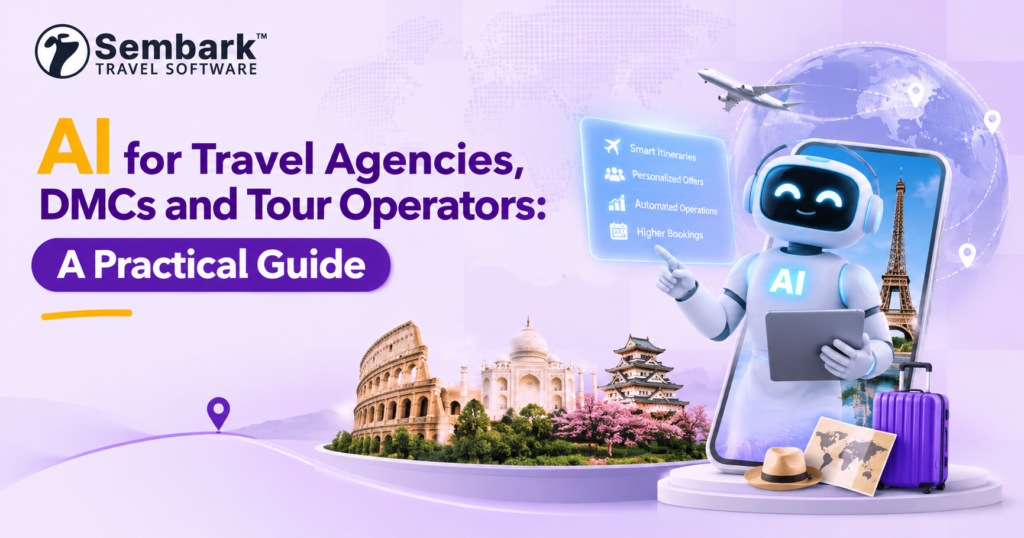
Sembark has three AI features for this. AI Email Reader turns enquiry emails into leads, AI Itinerary Importer turns a partner DMC’s quotation into your own, and AI Itinerary Builder drafts the itinerary. Let’s look at each one.
How Sembark Reads Your Enquiries & Supplier Packages
AI Email Reader: Enquiries that turn into leads on their own.
A lead can’t be quoted until someone notices it. Your enquiries share an inbox with invoices, supplier emails, payment confirmations and follow-ups, so the wait for a reply depends on who reaches which email first. For inbound operators and DMCs the problem is bigger, because most enquiries arrive as long emails from partner agents abroad, with several requirements packed into one message.
AI Email Reader removes that wait. Add your mailbox to Sembark, and AI reads every email as it arrives.
- It separates enquiries from other mails. It understands the whole email and sets promotional mail aside.
- It picks out what you need to quote. That means destination, travel dates, number of travellers and specific requirements.
- It creates the lead and assigns it. The right salesperson gets it within a minute, based on your predefined rules.
- It tags every email. Each one is marked Lead Created, No Enquiry Found or Parsing Skipped.
- It never creates the same lead twice. If a customer replies in a conversation that already has a lead, the system skips it.
Once the lead becomes a trip, the full email conversation stays inside it. Your team stops jumping between the inbox and the CRM, and admins decide which teams can read, use templates or reply from the mailbox.
AI Email Reader covers the email channel. It uses a separate credit balance, charged only when it is used.
AI Itinerary Importer: Supplier Packages That Become Your Own Quotations
A supplier or partner DMC sends you a package. You cannot forward it to your customers as iA partner DMC’s package can’t go to your customer as it is, because it carries their branding and their rates. The AI Itinerary Importer turns it into your quotation.
- Upload or paste in any format. Add a PDF, Word file or image, or paste the text from an email or WhatsApp message.
- AI reads the package in about 2 minutes. It fills your quotation with hotels, room types, meal plans, dates, transport, activities and extras.
- It checks against your system. Extracted details are matched with what is already in your records, so existing details are identified and additions stand out.
- You add the pricing. Enter your own cost, selling price and markup. The supplier’s rates never reach your customer.
- It comes out in your branding. The quotation matches your brand, not the supplier’s.
- Everything stays editable. Your team corrects anything the AI missed or misread.
- Share it your way. Send the quotation as a PDF or on WhatsApp.
Your team moves from rebuilding the package to reviewing it.
Building the Itinerary: Drafts From Your Own Rates and Past Trips
Any chatbot can write an itinerary, so that is not the real test. The real test is whose data the AI uses.
A general-purpose AI writes from general knowledge of a destination. It can produce an attractive quotation, but it does not know your hotel inventory, your preferred suppliers, your costing, your markup rules or your taxes. So you may get an itinerary that sounds great but is not something you can sell. A draft built from own past itineraries and contracted services is much closer to ready.
For a side-by-side comparison, read: A Better AI Alternative to ChatGPT for Creating Travel Itineraries
A general-purpose AI writes from general knowledge of a destination. The Sembark’s AI Itinerary Builder starts from your business.
- Four inputs are all it needs. Your salesperson selects Generate AI Itinerary and enters Trip Purpose, Tour Basis, Budget Tier and Destination-nights.
- It draws on your own data. That means your past itineraries, your inventory, your contracted services and the notes captured against the enquiry.
- You get a costed, day-wise draft in 1-2 minutes. Rates, markup and taxes come from Sembark’s costing workflow.
- Your team stays in control. They review the draft, add or remove what is needed, customise it, then save it and send the PDF.
- New salespeople start faster. A new hire begins from a generated itinerary on day one, instead of spending weeks learning how to build one.
- Your knowledge stays in the business. Past itineraries become the reference, so what your best people know remains when they move on.
The Builder uses a separate credit balance, charged only when an itinerary is generated.
Built-In Checks: What You Can See and Fix Before a Quote Goes Out
Sembark’s AI gives you a way to see what it did and fix it before anything reaches your client.
- Every processed email is tagged Lead Created, No Enquiry Found or Parsing Skipped, so you always have a status for it.
- A customer’s reply in an existing conversation doesn’t create a duplicate lead. It is tagged Parsing Skipped and stays linked to the trip.
- Imported packages open as editable drafts, with every hotel, transfer and activity listed for your team to check.
- You add your own cost, selling price and markup before the quotation goes out.
- Builder itineraries are drafted from your own data. Your team reviews and edits them, and nothing is sent automatically.
- Access is controlled per team and per mailbox: Read, Templates and Replies. You can also grant or remove permissions for individual users.
Where AI Stops and Your Team Steps In
Each AI feature hands over to a person before anything reaches your client:
- AI Email Reader: reads the enquiry, creates the lead and assigns it by your rules. Your team reviews the lead and converts it into a trip.
- AI Itinerary Importer: builds your quotation from the supplier package. Your team checks it, corrects it and adds your own cost and markup.
- AI Itinerary Builder: drafts a day-wise itinerary with your contracted rates pulled in. Your team reviews, edits and shares it.
What Still Needs a Human
AI can read, extract and draft. These jobs stay with your people:
- Reviewing what the AI produced. Your team reviews each lead and converts it into a trip, checks each imported draft, and edits each Builder itinerary.
- Pricing. Your team adds the cost, selling price and markup to imported packages and prices the Builder’s draft.
- Sending. Nothing the AI drafts is sent automatically.
- Selling. AI won’t close every deal. It removes repetitive work so salespeople have more time to discuss budgets, suggest upgrades, answer questions and follow up with customers ready to book.
Conclusion
You have run this business on your own judgement for years, and that is not going away. Travel is still a people business. Customers still want someone who takes responsibility when plans change.
AI can handle the repetitive, time-consuming work: reading emails, rebuilding supplier quotations and drafting first itineraries. That is the real transformation in tour operator software. Your team moves from typing to reviewing.
But this is where people still matter. AI reads, extracts and drafts. It does not decide how to price a deal for a key agent, negotiate with a supplier or look after a traveller when plans change. Your people check every draft and decide what the customer sees.
So, what if AI gets something wrong? With Sembark, your team can review and fix it before it reaches the customer. AI does the first pass, and your people make the final call.
Want to see it on your own trips? Bring a real enquiry email and a partner DMC’s quotation to a free 30-minute demo, and watch both turn into work your team can review.
FAQs
Q1. What if the AI gets something wrong?
A. Sembark’s AI does most of the reading and drafting for you, and can handle all tasks before any human intervention, but like any AI, it can still miss or misread a detail. That is why nothing is sent automatically. An imported package opens as an editable draft, and you correct anything that is wrong before sharing it. For a Builder itinerary, your team reviews the draft, swaps hotels or services, adjusts days, then saves it and shares the PDF. For emails, every one the AI processes carries a status tag, and you can open the lead to review the original enquiry.
Q2. Will AI replace my sales team?
A. No. AI helps your team sell, but it does not close the deal. Sembark’s AI takes over the repetitive work: reading emails, pulling out enquiry details, rebuilding supplier quotations and drafting first itineraries. Your team still reviews and finalises every lead, quotation and itinerary. They also get more time for the work only they can do: talking to customers, understanding what they need, tailoring the itinerary, following up on quotations and closing the booking.
Q3. Does the AI set my prices?
A. No. With Sembark, prices come from your own contracted rates and markup, not from the AI’s guesswork. With the AI Itinerary Importer, the AI reads the supplier package and builds the quotation structure (hotels, transfers, activities, extras). Your team then adds your own cost price, selling price and markup before anything is shared. With the AI Itinerary Builder, your contracted rates are pulled in automatically, so the draft comes already costed. Markup and tax follow your Sembark costing settings. Nothing is sent automatically, and your team reviews and finalises the quotation first.
Q4. Is ChatGPT enough for making itineraries?
A. ChatGPT can certainly help create itineraries. However, creating an attractive itinerary and creating a commercially viable quotation are two different things.ChatGPT can write an itinerary that reads well, but it writes from public knowledge of a destination. It doesn’t automatically know your contracted hotels, suppliers, costing or markup, so you can end up with hotels you have no rates with, activities you don’t operate, and no price. Sembark’s AI Itinerary Builder works from your own past itineraries, contracted hotels, transporters and services, and the notes your team recorded. It also stays within the city-night routings you’ve set, so the draft is something your team can actually sell.
Q5. Is my data used to train an AI model for other companies?
A. No. With the AI Itinerary Builder, your itineraries, contracts and supplier notes are used only to generate itineraries for your own company. They are never used to make recommendations for another Sembark customer. The Builder works from what is already in your account: your past itineraries, contracted hotels and services, and your team’s notes. Access inside your account is controlled by user roles, with permissions you can grant or remove for individual users.
Related Blog